
#00037 - The ultimate reckoning for RH
Exclusive: How Chinese dupes are tearing down Gary Friedman’s empire

Dear Readers…
I started Mr. Thread to solve a problem in my own business. All the news, trends, and data I needed were scattered everywhere. The macroeconomic news that drives our industry was nowhere to be found. There is no index that tracks our niche. Between stock prices, index funds, interest and mortgage rates, piecing together the economic environment we operate in was nearly impossible.
And without timely news, it’s hard to run your business. Especially as a control freak. You end up on calls with competing colleagues asking the age-old question: “How is business? How is your year going?” And because so many of us are so insecure, the answer over 90% of the time is: “Best year ever!”
So I set out to build Mr. Thread: a weekly journal that scours news from thousands of sources across the web and print, to help a creative industry run better businesses. Just researching Mr. Thread has made me a more informed businessman, and it has surfaced opportunities I never would have found otherwise. Readers dig it too. Just last week, a design firm paid for subscriptions for every one of its employees.
Six months working with our West Coast editor, Mr. Weft, turned up a pattern: stories that should have been reported and weren’t. One kept surfacing. In our research we ran into agents and factories offering top-quality furniture direct from the source—including copies of prominent American brands like RH.
So we dug in. Six weeks of research and interviews later, here is the first original Mr. Thread investigation. It’s crucial news about our industry, and about what becomes possible when anyone can transact directly with a factory.
As always, you will find our Loose Threads at the bottom, plus Playtime.
Thanks again for joining us at Mr. Thread. We’re happy you are here.
See you next week,
Mr. Thread
🧵 MR. THREAD EXCLUSIVE
How Restoration Hardware Got Duped
Inside the Chinese furniture city reverse-engineering the entire RH catalog
IN THE WINTER OF 2025, Chloe McGrath* flew from her home in New York to start a new life in Hong Kong with her husband. She soon found herself at the window of her new apartment, looking out at the twinkling skyline—thousands of towers, lit up at night, stacked with seven and a half million people on a strip of land wedged between the mountains and the sea. “It was an adventure moving to Asia,” she says. There was only one problem: their apartment was totally unfurnished. It was like living in an empty box.
“The furniture options in Hong Kong were really limited,” she says. There were designer Italian galleries priced for hedge-fund money, or IKEA and Zara Home. What she wanted was something more like Restoration Hardware. “The RH-style stuff that’s really popular, especially in America, it’s actually quite minimalistic,” she says. It was also expensive. What if they spent a fortune on sofas, and Hong Kong didn’t work out?
At first Chloe outsourced the problem. A woman in Hong Kong made her living sourcing furniture directly from Chinese factories on behalf of expat clients, and Chloe hired her. She ordered a few essential items, and they were affordable and well made. “But she has a little bit of a different style than us,” she says. And so she set out to do it herself.
On Reddit Chloe discovered a small, obsessive community that had figured out how to buy furniture directly from Chinese factories that copied famous American brands like RH and Arhaus. She started chatting with sellers on WeChat and WhatsApp. One was a sales representative who went by Rose, who handled international sales for a factory in Foshan called Zhenúr. Rose sent her a catalog. It ran to 148 pages.
The PDF was bilingual and organized like RH’s doorstep-sized catalog. There were chairs, coffee tables, side tables, dining tables, even outdoor furniture. The first thirty pages were sofas—long, low, modular designs in cream and ivory and dove gray, photographed in airy white rooms, just like RH. The prices were astonishing. “They’re able to make basically anything you would get from a Western retailer for a fraction of the cost,” Chloe says.
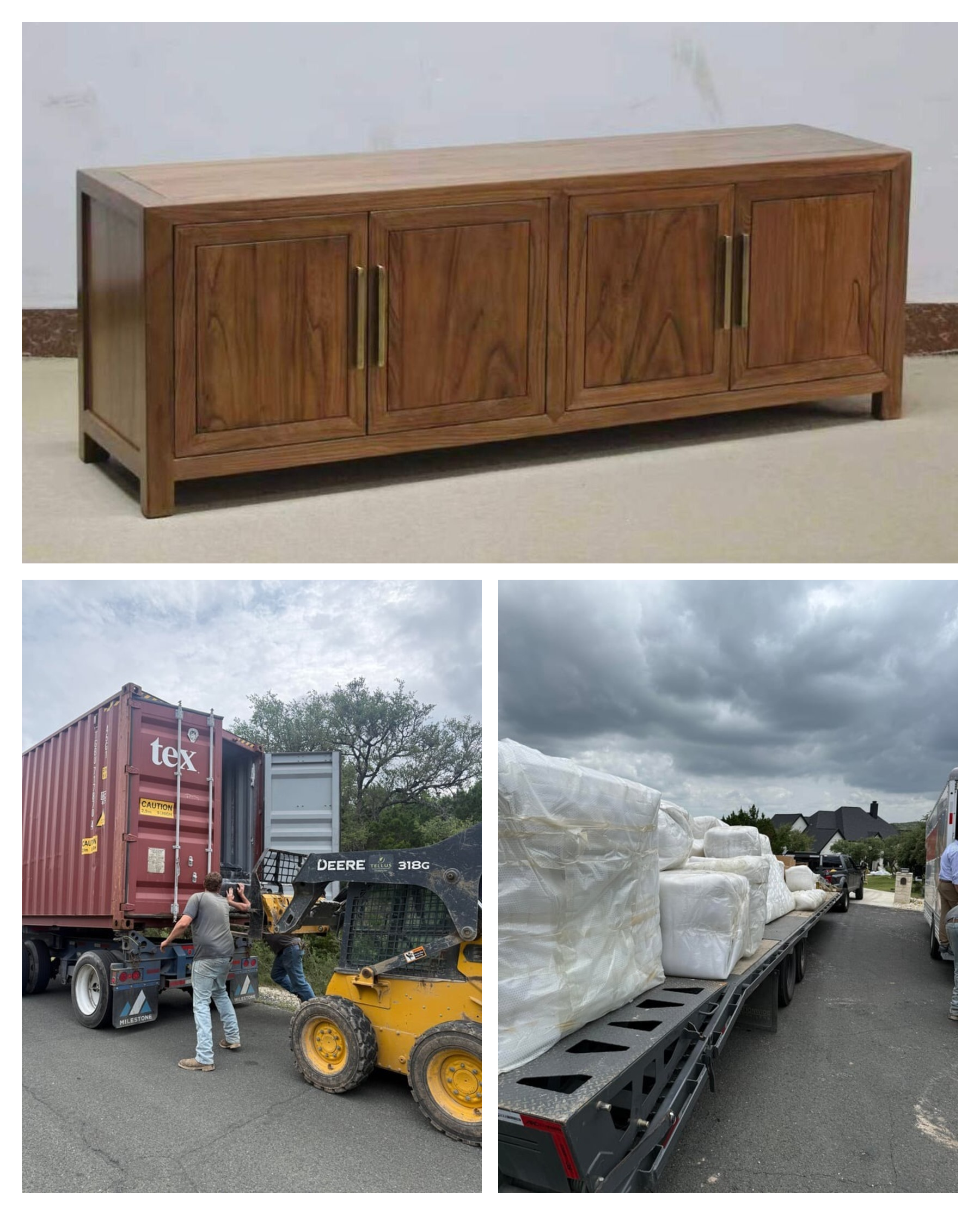
She would eventually order a bed, a desk, an office chair, a dining table, a bookshelf, and a coffee table. The process was easy—easier, in fact, than buying from a store, because she could have anything made to her own specifications. “In Hong Kong apartments, the configurations oftentimes can be a little bit obscure,” she says. One evening she sketched a media console with her husband using ChatGPT, sent the drawing to the factory, and they made it in solid wood for $650.
The pieces arrived one by one and they were good. Solid wood, tight joints, cut to the exact centimeter of her strange rooms. She began to think about the rest of the apartment, and how she could furnish the whole place for rock-bottom prices. Foshan, the largest furniture-manufacturing city on earth, was just ninety minutes north of her new home. She applied for a Chinese visa, and when it came through, she booked a hotel in Foshan and left on another adventure, to the heart of China’s furniture industry.
“A lot of people thought I was a little crazy,” she says.
CHINA AND HONG KONG account for 79% of the counterfeit furniture seized at American ports, according to figures US Customs and Border Protection provided to Mr. Thread. In fiscal years 2024 and 2025, the agency’s officers took 23,700 such items, with a combined retail value, had they been genuine, of $992,000. So far in this fiscal year, a spokesperson said, they have snatched more than 6,000 items worth over $1.9 million. Compared to the rest of the counterfeit trade, those numbers are almost invisible. In fiscal year 2025 alone, CBP seized more than $7 billion worth of knockoff jewelry, fake watches, and counterfeit handbags. Last August, officers at the Port of Indianapolis seized a single shipment from Hong Kong containing thirty fake Cartier watches. Had they been real, they would have been worth $4.2 million—more than four times the value of every counterfeit chair, sofa, and bed the agency caught in two years.
The furniture factories of China are no longer waiting for customers to find them. Last spring, as the trade war escalated, TikTok filled with videos of workers strolling factory floors, offering Americans the same goods they claimed to build for famous brands—minus the label and the markup. CBM Living, a Dongguan operation, promises furniture “made in the same factories as the RH originals, in the same materials and same craftsmanship.” This claim is unsupported by US customs records: RH’s documented Chinese suppliers do not advertise dupes, and no dupe seller appears in RH’s bills of lading.
That hasn’t stopped the hashtag #chinesefactory from rocketing past 31,000 posts on TikTok. One lifestyle creator boasted that he had furnished his entire home with heavily discounted RH-style furniture bought straight from the source. When Business of Home went looking for the sellers behind the videos, it found WhatsApp numbers, automated replies, bounced emails, and no proof that anyone had ever received a sofa.
Today, most of the action is happening on Reddit. The site is full of Americans buying copycat furniture straight from China—posting receipts, reviews, shipping horror stories, whole homes furnished from a phone. One buyer ordered so much that he had to rent a forty-foot shipping container, then posted photographs of it being unloaded by crane, somewhere in the Midwest.
The copycat furniture industry is thriving, and nobody is stopping it. In this investigation, Mr. Thread asks why—and what furniture companies can actually do about it.

Fake furniture, it turns out, is not always illegal.
Daniel C. K. Chow has written about Chinese counterfeits since 2000. Before he was an academic he ran Procter & Gamble’s legal department in China, where part of the job was suppressing fakes. He has the calm demeanor of a veteran lawyer and is not given to dramatic phrasing. When Mr. Thread describes Chloe’s catalog, Chow is unmoved. He says it might not be breaking any laws at all.
“There is a lot of furniture that you can copy without violating anybody’s rights,” Chow says. “If somebody has a piece of furniture for which they do not have any type of IP protection—either copyright, a trademark, or design patent—anybody can copy that.”
American law draws a hard line between two things: copying a shape, and copying a label. “In the United States, fashion is not protected by copyright,” Chow explains. “That’s a longstanding rule.” A knockoff of a Christian Dior dress is lawful in America; you just can’t put the Christian Dior label on it.
Furniture could be protected, he says—if RH held a trademark on a shape, or if the copies carried its name. But there is no mention of Restoration Hardware or even RH in Zhenúr’s catalog, or anywhere on its products.
“If they’re just copying shapes that are out there,” Chow says, “that’s not protected. There’s nothing wrong there.”
Buying from a Chinese catalog is also not a problem for customers like Chloe; federal law only goes after traffickers. “Generally, the law is not concerned with the consumer,” Chow says.
According to Chow, RH’s options are thin. It could petition the International Trade Commission for an exclusion order barring the furniture from entry (“It’s not easy”) or register its trademarks with Customs, obliging officers to seize copies at the border. “The problem with all of this, of course, is that most of it is smuggled in,” he says, meaning shippers list it as something else on the customs paperwork.
Nor have the trade-war tariffs helped. “The tariffs are not going to affect the counterfeits,” Chow says. Even ending the de minimis exception—the rule that let low-value packages skip duties and formal customs processing—didn’t change much: shipments face more scrutiny now, but scrutiny isn’t the same as catching them. “It’s impossible,” he adds. “There’s something like 3.2 million packages a day that come into the United States from China.”
Asked whether a buyer filling a forty-foot shipping container to furnish a single apartment would draw scrutiny, Chow is indifferent.
“Probably not,” he says. “The volume of things that come into the United States—that’s like a speck of sand on the beach.”
CHLOE ARRIVED in the Pearl River Delta on a gray spring day. It is an impossible urban sprawl, of which Foshan is a single city. The sky was hazy. The highways ran six lanes wide, and the city seemed to go on and on: nine and a half million people, more than Chicago. One business dominates here: furniture. Tens of thousands of businesses fill the district of Shunde: the showrooms of Lecong, the factories of Longjiang next door.
Google Maps on Chloe’s cellphone didn’t work (all Google services are completely blocked in mainland China by the country’s “Great Firewall”). There was no Uber—only Didi, the Chinese version. “It’s quite complicated to navigate the region if you don’t know Chinese, and I know very little.” Luckily Rose, her contact, had the Zhenúr factory owner, Kevin, pick her up from her hotel, which was attached to a wholesale furniture mall called the Louvre, a colossal neoclassical building boasting millions of square feet of showrooms.
Chloe found the lobby bustling with people from all around the world, a kind of Star Wars cantina for the furniture industry. “Lots of people from India and the Middle East,” she recalls. They had come, with agents and translators, for a week at a time. Many were furnishing entire houses. “There’s like a whole tourism market for this,” she adds. Factories even send chauffeur-driven limos to ferry customers to their showrooms.
Zhenúr had no street address, and scant details online. She was given a tour of the factory floor and afterward enjoyed a cup of tea with Kevin, the factory owner. They talked about “the opportunity of doing more of this distribution, essentially to people in North America,” she recalls. An industry is already assembling around this new pipeline: agents, middlemen, shippers, fixers. And there are fortunes waiting for designers—any who can deliver luxury-looking rooms at extraordinary discounts, so long as the client will accept a dupe (or be savvy enough to know the difference).
To Chloe, the factory was fascinating and the products looked outstanding. “It’s all handcrafted,” she says. “The materials are just as nice as what you find at home, if not nicer.” The workers were all men of about forty, she says, though Kevin told her it was getting harder to find staff, because the younger people don’t want to work in factories.
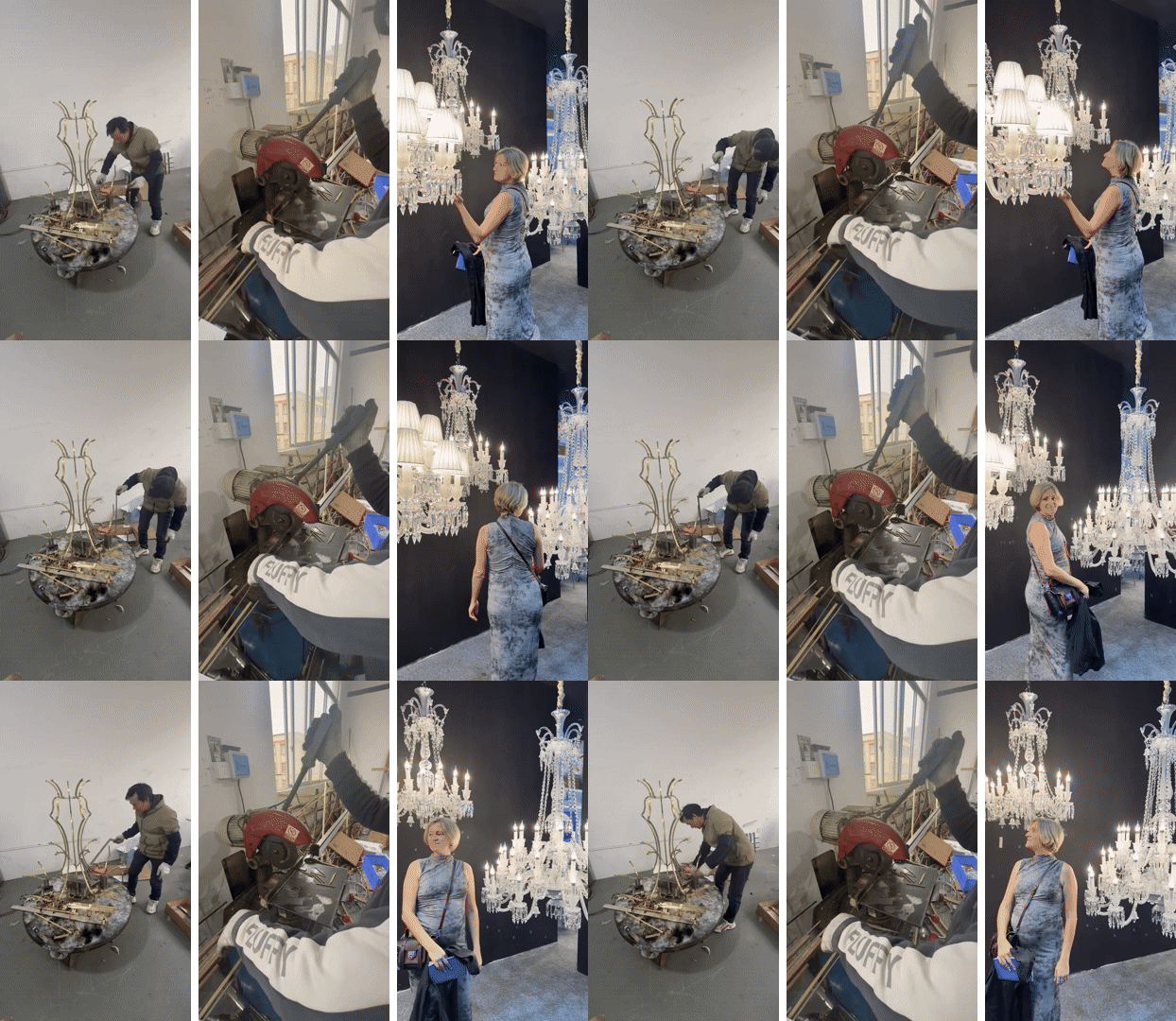
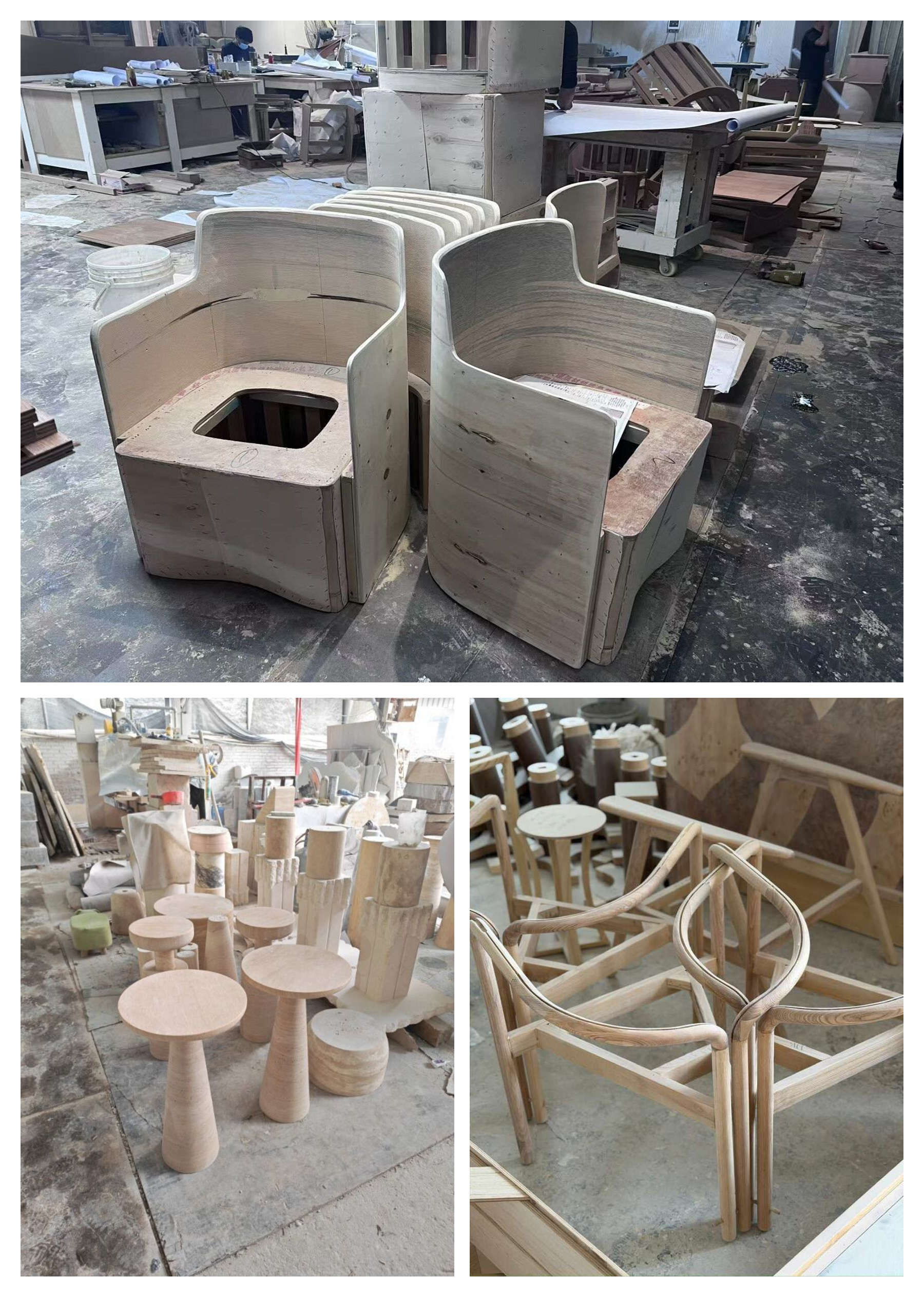
On the factory floor, skilled craftsmen were putting the finishing touches on a five-drawer dresser in white oak, which was an exact copy of RH’s “Milos” by Harrison and Nicholas Condos. Described on the brand’s website as a “marriage of modern aesthetic with ancient Greco-Roman inspiration,” it features architectural fluting and costs $4,995. Zhenúr sells it for approximately $600, mostly to American consumers. When reached via WhatsApp, a representative for the factory declined to answer any questions about the business.
According to the intellectual property experts consulted by Mr. Thread, Zhenúr is breaking no laws—but other factories in the Foshan area are less careful. CBM Living makes no secret of how it copies American brands. “Shop the Best Restoration Hardware Dupes,” its website reads. “Love the iconic RH aesthetic without the luxury price tag? Save 60–70% on Luxury Furniture.” Another, rhmaker.com, was offering hundreds of RH-inspired products before the site vanished last month. During our investigation, Mr. Thread found many other similar factories in Foshan, and so did Chloe.
She visited a dozen factories, but one in particular gave her pause. “The vibe was pretty grim,” she says. They handed her a dust mask at the door. The workers had taken theirs off, because there was no air conditioning and the day was warm—“it’s not even the hottest it gets here. I can’t imagine what it’s like in August,” she says. She only stayed ten minutes. “I couldn’t imagine inhaling those kinds of fumes all day.” She did not buy anything.
She had already fallen for an exact copy of a Maralunga sofa from a Chinese factory that specializes in custom sofas. The original—a low-slung, deceptively simple design by Vico Magistretti for Cassina, introduced in 1973—is one of the most decorated pieces in postwar Italian furniture. Today it retails for up to $20,000. The Chinese factory, which has been in business for more than twenty years, offered it to Chloe for a fraction of that. “After confirming the fabric, it was made in less than a week,” she says. “Just incredible.”

FURNITURE DUPES ARE NOT a new problem. In 1956, Charles and Ray Eames invented the Lounge Chair, three shells of molded plywood cradling black leather cushions, built to look, as Charles put it, like “a well-used first baseman’s mitt.” It instantly became one of the most copied designs in the United States. By 1963, the counterfeits had gotten bad enough that the Eameses took out a full-page advertisement warning American consumers about rip-offs.
The Lounge Chair is now seventy years old and still in production. An authentic one, sold through Herman Miller’s sister brand Design Within Reach, starts at just over $7,000. It also remains one of the most copied objects in furniture. You can buy dupes in broad daylight on eBay, Facebook Marketplace, and Craigslist for as little as $400.
This is because the chair’s shape itself is public domain. The patents ran out decades ago, so anyone can build the plywood shells and leather cushions and sell it legally. The last line of defense is “trade dress”—the claim that the silhouette alone is recognizable enough to confuse buyers—and it has given Herman Miller real legal wins, including a $3.3 million judgment against a company copying its Eames office chairs. Even then, an appeals court clawed back a further $3 million, ruling the Eames design wasn’t “famous enough” to deserve extra protection.
But how safe can a $400 Chinese lounge chair be? And how many corners must be cut in the manufacturing process to turn a profit? Furniture sold in the US must meet federal formaldehyde emission limits under the TSCA Title VI rule, and—under California law—carry a label disclosing whether its upholstery contains added flame retardants. None of the Chinese catalogs inspected by Mr. Thread made any claims about either.
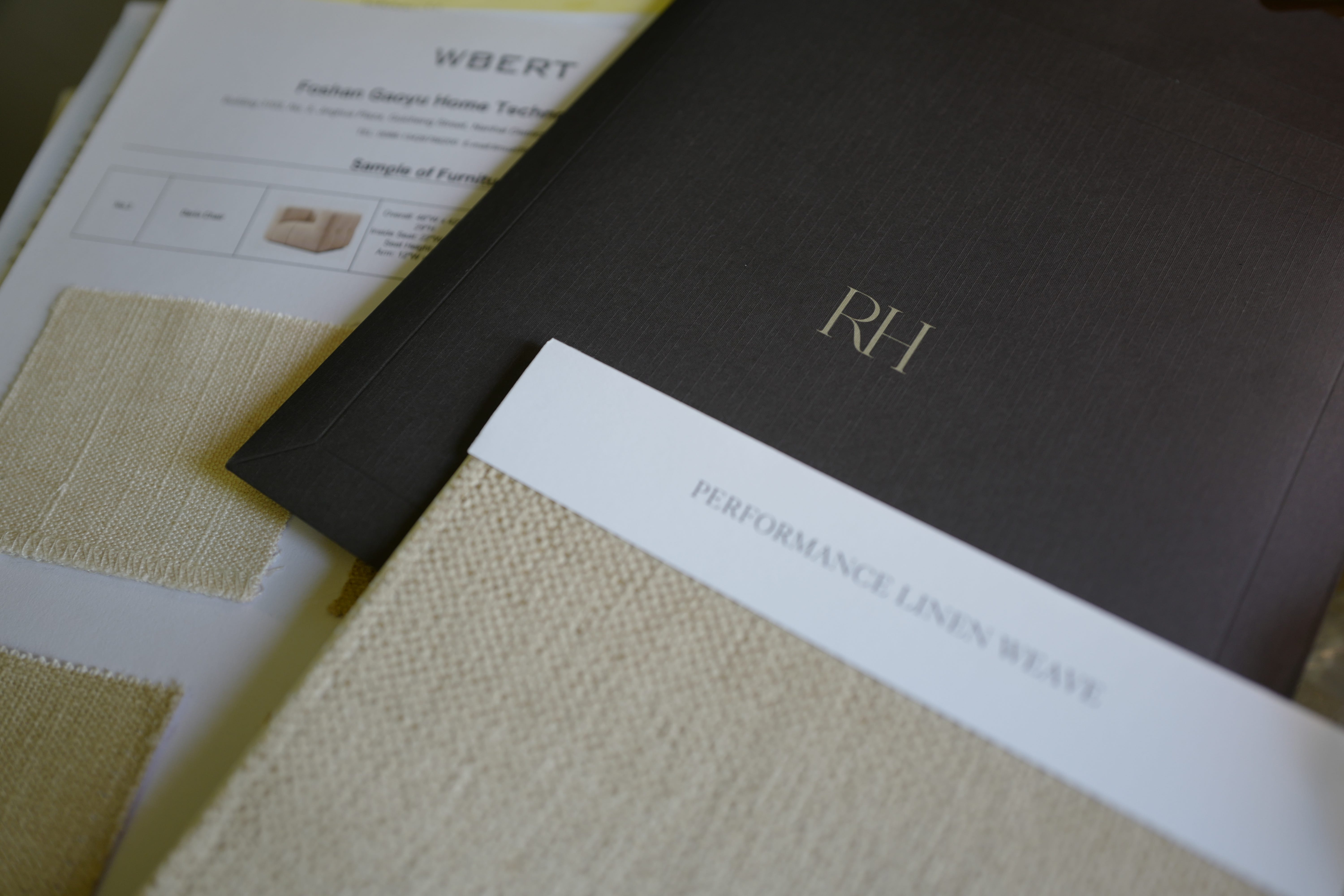
IN THE NAME OF SCIENCE, Mr. Thread ordered sofa fabric samples from a company named “RH Maker Furniture” based in Foshan, and from an official RH store in Thousand Oaks, California. We shipped them all to Heather Stapleton, Ph.D., an environmental chemist at Duke University in Durham, North Carolina, who has spent nearly two decades testing materials pulled from American sofas.
The results came back in early July:
“We were able to screen the five textile samples shipped to our laboratory for hazardous flame retardant chemicals. All came back negative. We did detect several plastic additives that are commonly found in furniture, but none of the concerning brominated or chlorinated flame retardants that have been of concern in previous studies.”
Negative for both suppliers. An $11,000 RH Cloud sofa and a copy that crosses the Pacific for a fifth of the price came back, in the one respect Stapleton’s lab can measure, identical—and clean.
None of this arrives at a restful moment for Gary Friedman. RH’s chairman has spent the past year blaming tariffs, a frozen housing market, and the war in Iran for a run of earnings misses that drove the stock to a five-year low in early spring—down more than 40% from its January peak. It has since partially recovered; Friedman sold $20.6 million of his own shares in July. But there is little he can do to stop factories in Foshan selling his own catalog to his customers at a fraction of the price, entirely within the law. When asked for comment, a communications agency relayed a statement from RH’s internal PR department, known as “the Truth Group.” They wrote: “Gary Friedman, RH’s Founder, Chairman, and CEO, is the sole spokesperson for the brand, and unfortunately, we’re unable to accommodate an interview or provide quotes at this time.”
*
NOT LONG AFTER HER TRIP to Foshan, Chloe finished her project and completely furnished her new apartment. “We’re still waiting for a few final things,” she says. “[We] recently placed an order for a sideboard, lamp, and even art.” When Mr. Thread asks whether she would tell guests at a dinner party where the gorgeous wooden media console in her living room had come from, she laughs. “One hundred percent,” she says. There was, in her view, a better way to buy furniture than the one Western retailers had built. The Chinese factories are good. The work is good. The people, when you meet them, are incredibly kind. The thing standing between the American consumer and the Foshan factory floor was, in Chloe’s phrase, “the trust layer.”
She has become, in six months, a Foshan evangelist. Friends and family in the United States are beginning to route furniture orders through her. Her mother-in-law, in Miami, is finishing a condo by way of WhatsApp. There is a desk that her mother-in-law had seen on a US-based furniture store’s website for $8,000. A factory in Foshan quoted Chloe the same piece, made to the same dimensions, for just $1,880. The shipping, in a wooden crate by sea to Miami, would be roughly $340. The piece would arrive in forty-five days. Incredibly, that’s just as fast as RH itself, which quotes 45 to 60 days for shipping.
When Mr. Thread visited an RH gallery in California, a couple stood inspecting the brand’s famous Cloud modular sofa, the husband working a tape measure over its three sections. They left without speaking to a sales associate. It was hard not to wonder where the order would be placed that evening—and whether the showroom, long considered the “moat” around brands like Restoration Hardware, is quietly becoming the opposite: a fitting room for the factories of Foshan.
As for Chloe, she’ll never look back. “I personally never want to buy furniture again the traditional way,” she says. 🧵
*Names marked with an asterisk have been changed at the subject’s request.
🧵 LOOSE THREADS
An oldie but goodie on how algorithms are to blame for all coffee shops looking the same.
It’s amazing to see the new generation fall in love with old-fashioned skills. This is a real positive development for the next human Renaissance.
We always knew beauty was good for you, now science confirms it. Our industry needs to lean into this as we are uniquely capable of providing this essential human need.
We still cannot escape the tariff lunacy. This is only related to our Canadian neighbors up north, so it is more contained. But another thorn in our side nonetheless.
🎲 PLAYTIME
Nine sharp Threaders nailed last week’s riddle! ✨ Congratulations to Amy G., Martin R., Chad S., Hillary E., Rico V., Tullia P., Freddy V., Robin D., and Jan W. for correctly solving the puzzle last week: EXPOSURE!
(The clue: Photographers and self-promoters are obsessed with it, you can get arrested for it, and it can even kill you!)
THE SEASON FINALE IS HERE! Threaders, we’re down to the very last game before the grand raffle on July 29th! This is your final opportunity to pile up your points before the prize drawing next week. Don’t leave your luck on the table. It’s playtime!

The Clue: You’ll find one living thousands of miles from home
Piece together the mystery word based on the clue provided above.
Click the button below then type your answer in the subject field and hit send!
The Stakes
Every correct guess earns you points that accumulate for our upcoming raffle. The more you play, the higher your chances of winning. We’ll be holding the grand draw on July 29th! Our lucky winner gets:
A featured spotlight for you/your firm in an upcoming issue of Mr. Thread.
Another special mystery gift from yours truly, Mr. Needle.
Stay sharp,
Mr. Needle