


THE PRESS LOVES MR. THREAD:
“Subscribers are privy to Mr. Thread’s sometimes unbridled perspective on the design industry...[It’s] a fresh take on the industry.” —Women's Wear Daily
Hello readers…
Halloween was always a weird holiday in our house. My parents came from Egypt, and the whole thing felt very foreign to them. Everyone dressing up, letting loose, being whoever they wanted to be. They were a little freaked out by it. We were never prevented from having fun, but we proceeded with caution.
With my own kids, we’ve gone the other way. All three love Halloween. My wife decorates everything, the pumpkins come out, and the house starts to feel like fall. It’s lovely. Meanwhile, my neighbor has this spooky white curtain thing with a blue light coming out of it. It moves in the breeze and looks like it contains the spirit of death. Scares the shit out of you when you walk past. There seems to be no end in sight for the holiday lawn and home decorating craze.
Our industry should be very good at this holiday. We’re theatrical. We’re colorful. We’re certainly not short of characters. But if you want to know what’s really frightening me this year, it’s not Home Depot’s lawn skeletons; it’s building a content machine.
At my company, we’ve almost entirely shifted to a long-form content strategy showcasing the people and the process behind our products. Which made it a pleasant surprise to hear the news below about Instagram moving into long-form content, called “Features.” They’re allowing selected creators to upload videos of up to 90 minutes, or, as we used to call it, “television.” It’s a limited rollout, so don’t start filming your own Nathan Fielder-length documentary on your iPhone quite yet.
Instagram’s shift makes me feel we were right to move into long-form content six months ago. Reels and shorts can feel gimmicky and cheap. Pollution for the mind.
I don’t want to build a luxury brand on TikTok. I want people to see where an idea comes from and how our artisans develop it. We have a hundred years of content gold. Why squeeze it into a ten-second clip?
Even our lean operation takes six people: a digital marketer, a coordinator, a creative director, a storyteller, a producer and a video editor. Then you’ve got to get everyone working from the same brief and actually make the film. You can’t half-ass it.
AI can help with the research or get a pitch deck together faster. We even use it to help organize the work. You still need all these human tastemakers across the chain. To do it soulfully, to make really good content, there are no shortcuts. It’s fucking work, and we have the bumps and bruises to show for our efforts. My company is the embodiment of the old saying, “you have to suck at something before you get good at something.” And I’m proud to say that after a lot of sucking, our content engine is finally starting to become great!
I’ve tried expensive agencies, tiny agencies, and plenty in between. I’ve often felt something missing in the result. We’re getting more organized now, and over the last few months I’ve seen a real change in the quality of what we’re making. I think it’s quite beautiful. That makes me want to keep climbing.
We are going to try in this journal to share some of the insights from our experience in case you want to take on the scary task of doing it for your own business. Hopefully we can spare you some of the terrors we faced. Let us know how it goes!
Meanwhile, Mr. Weft has investigated the fright in China’s AI bubble bursting, and how that will affect you and me. This is crucial information to pass on to your creative and marketing teams.
Have a happy Halloween and see you next week for issue #00052!
Mr. Thread
🏭 INDUSTRY

Can scarcity be a winning strategy?
I’ve tried the “scarcity strategy” with fabrics at one of my companies. You know, “get it before it’s gone.” It never really seemed to work. Actually, it fought against us. A client might like the idea of having something the Joneses can’t get their hands on, but it might give their designer anxiety: what if I need to reorder? What if we haven’t allowed enough?
Fashion brands like Supreme have trained customers to “chase the drop,” i.e., get excited to overpay for “limited edition” items. And this week Business of Fashion’s Mike Sykes makes a useful distinction between products that are scarce because somebody has to make them by hand and products held back to manufacture excitement. Designer Emily Dawn Long tells Sykes that she keeps production small enough for her team to stay involved with every garment. That is what I’m calling “genuine scarcity.”
In my experience, no one buys interior products on a whim, like they might with a Supreme skateboard. I wanted purple fabric in my office and I wouldn’t have taken green because somebody made it a limited edition. No one’s gonna buy a two-seater sofa for a room that needs a three-seater because it’s “rare.” I’m not convinced the scarcity model could work with interiors. Can you make designers panic-buy yardage? Have you made it work? Tell me about it.
“Delayed gratification isn’t a strategy we adopted. It’s a condition of doing it properly.”
— Emily Dawn Long, designer, speaking to Business of Fashion
The D&D’s new collective needs more than a good idea
Cohen Brothers Realty, the D&D Building’s embattled owner, has become a multi-line showroom operator. Business of Home reports that The Collective now occupies 6,500 square feet on the fourth floor. Brands can license a bay, use a shared sample room and get help from a dedicated showroom director. It opened with 11 tenants.
A Mr. Thread operative who toured it a few weeks ago found it “depressing.” The build-out felt thin, and it was hard to imagine anyone getting excited to bring a client there. Jim Druckman tried it at 200 Lexington and it worked brilliantly. The idea is sound: a small niche design center inside a larger one.
But this is executed in such an uninspiring and cheap way. It’s also in a poorly lit hallway that makes Bellevue look like the Ritz. It’s hard to see designers wanting to shop here, or serious brands wanting to display here. Which is too bad, because the building could use a new idea like this to provide a jolt of energy.
Until then, take this as another warning shot that things are not good at the D&D.
“Some might say design centers are becoming obsolete, but I disagree. They’re just changing.”
— Matthew Kurzban, vice president of leasing at Cohen Brothers Realty, speaking to Business of Home
💰OPPORTUNITIES

Put Morocco on your sourcing list
Sofia Celeste’s report for WWD has got me wanting to look more seriously at Morocco for sourcing. The first Morocco Design brought exhibitions and showroom events to Casablanca this month. Included in this feature are Sophia Kacimi’s Zoubida, which works with the textile traditions of Fès, and Sana Benzaitar’s contemporary rug studio. Moroccan Bazaar is already supplying projects for the Four Seasons hotel group.
This craft culture in Morocco is top-notch. It produces some of the most intricate and unique products the world has to offer. But you should know that finding the right partners can be difficult. If you’ve ever wandered through a souk in Marrakech, you’ll know traders are passionate, but cut-throat.
If it were me, I’d start with a sample commission to test the waters before promising a client a delivery date or committing to a new product line from a vendor.
If any of our readers do business in Morocco and know more about it, please share with our community in the comments.
Prefab is having a moment
The Spaces just put together a roundup of exciting new prefabs. It includes an Eames Office and Kettal pavilion, Konga’s timber cabins and a sauna made in Colorado. Some arrive furnished; others need a designer. There’s an opportunity for someone to specialize in small footprints.
My eye was drawn to Koto’s garden suites at Moor Hall. That project opened in 2024. Just marvel at the black-stained oak, botanical color schemes and private terraces. If a client wants a garden guest room or an extra hospitality suite, find out what the shell includes and what the site needs before falling in love with the brochure. Then get to work on the inside. That’s where you really earn your money.
📊ECONOMY

EVEN 0% — No change to interest rates announced by new Fed boss Kevin Warsh. Don’t expect this to last: the Mortgage Bankers Association forecasts a rate increase in December and another in the first quarter of 2027.
DOWN 9% — Gucci’s sales through its own stores and ecommerce fell in the third quarter on a comparable basis. Kering’s release puts Gucci’s total comparable revenue decline at 6%. Oof!
UP 7.5 points — The Conference Board’s Consumer Confidence Index rose to 91.7 in October. It measures how consumers feel about business, jobs and their own financial prospects. Things are looking up. Maybe this isn’t a terrible time to reopen a postponed conversation with a client.
UP 3.4% — Mortgage applications rose from the previous week, according to the MBA’s seasonally adjusted measure. That total includes refinancing. Applications to buy homes were still 18% below a year earlier.
$4.3 billion — Halloween decorating spending projected in 2026 by the National Retail Federation.
China’s AI fright comes home
A Mr. Weft dispatch from Los Angeles
I used to see a lot of homes in my neighborhood priced at $1,888,888. That number used to tell you something about the buyer the agent hoped to attract. You see, the number eight has an association with prosperity in Chinese culture, and I can’t tell you how many homes I lost out on to Chinese bidders buying sight unseen.
China’s AI stocks have taken a beating over the past four months. Reuters reports that China’s STAR50 technology index has dropped 40%. About $480 billion in market value vaporized. Turns out investors had paid extraordinary prices for the companies supplying the AI boom. Then the rug got pulled. A lot of Chinese investors just lost buckets of yuan.
“What’s happening is now going to put a stop for many of the companies trying to get themselves listed.”
— Hong Hao, chief investment officer, Lotus Asset Management, speaking to Reuters
For those of us watching California property, the retreat was already under way. The National Association of Realtors’ latest survey says Chinese buyers spent $7.6 billion on existing U.S. homes in the year ending this March. That compares with $13.7 billion in the previous survey. Basically, nearly half the spending has gone bye-bye. In the San Gabriel Valley and Palos Verdes areas, brokers also reported fewer Chinese buyers in 2025, saying there was a bit of market uncertainty and difficulty moving money out of their homeland. This Halloween AI fright could deepen the problem. But at least it might make homes in the $1.8m region more accessible to American buyers.
📈TRENDS

Is everything Farrow & Ball now?
Alex Shoemaker at Family Handyman has done us a favor. He’s gathered all the paint companies’ colors of the year in one place, so we can look at what they’re all trying to sell us for 2027. A couple of them really suck. The rest are really nice and seem accurate to what I am seeing in my own internal data. But as I went through them, something started nagging me.
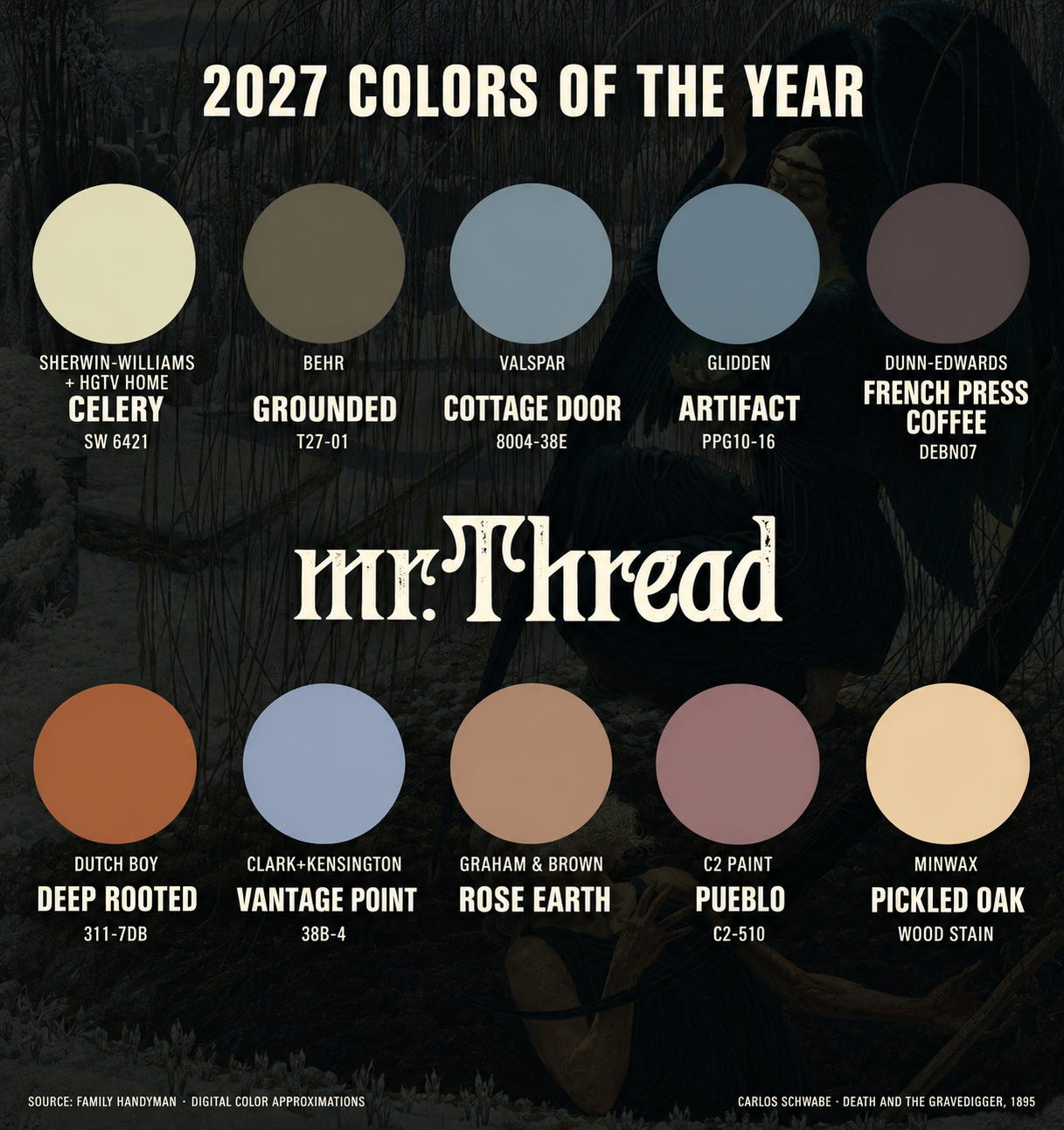
Look at the muddied greens and those pinks that are almost brown. Is it just me, or are most of these 2027 colors inspired by Farrow & Ball’s latest and most popular colors? I pulled up F&B’s new-colors collection that launched in February 2025, just to be sure, and…
Check this out:
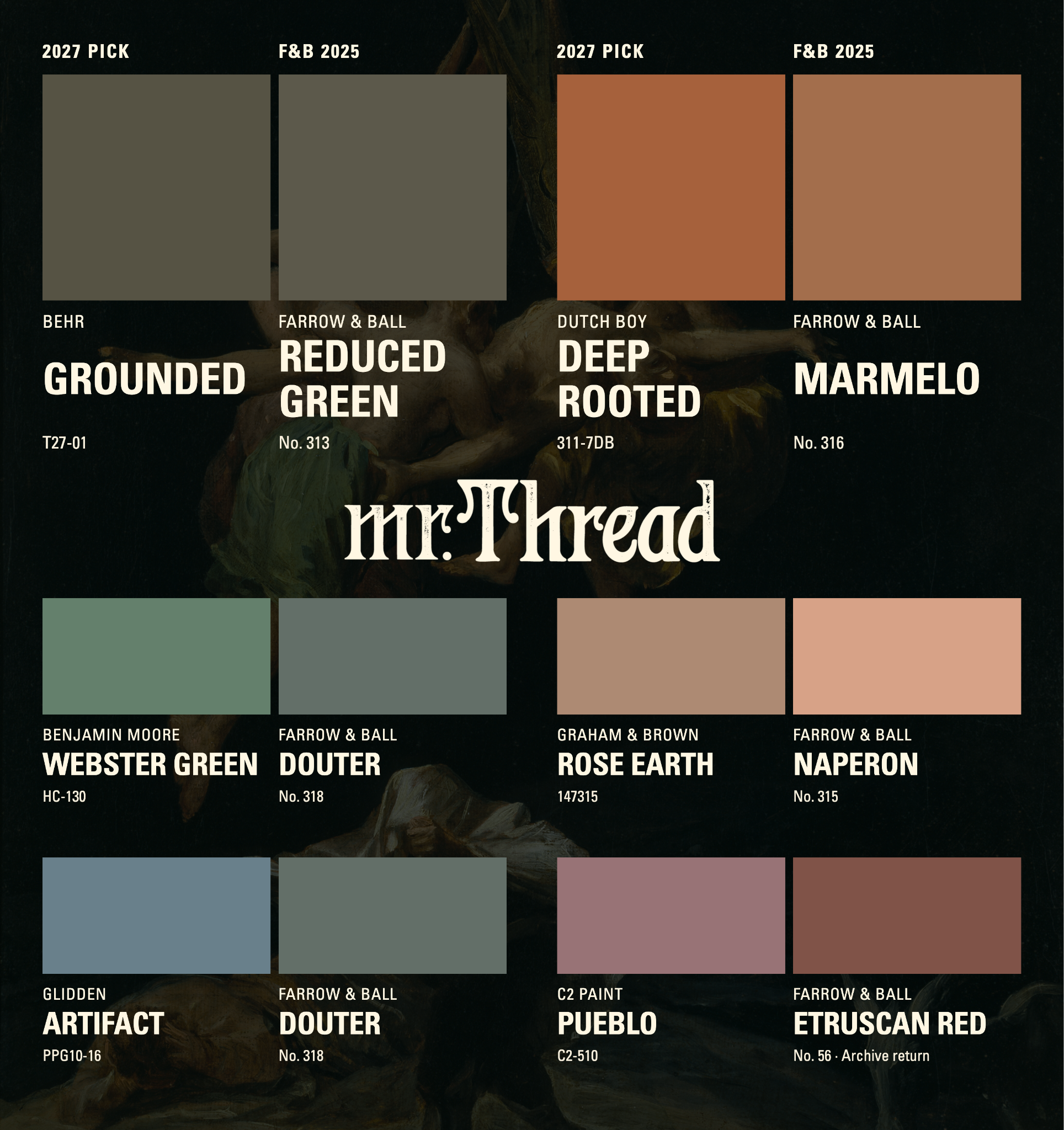
Behr’s Grounded looks almost exactly like Reduced Green. Dutch Boy’s Deep Rooted is a slightly more orange Marmelo. I mean, look at them. These are supposed to be the colors of 2027, and F&B was selling almost the same colors in February 2025. Two years earlier! What on earth is going on?
Give F&B some credit. They’re leading the charge. They’ve built a business around people trusting their taste enough to pay a serious premium for a can of paint. Anyone who’s watched a client agonize over six nearly identical whites knows how much that confidence is worth. They’ve earned their reputation as color trendsetters.
Forward this to your design and sales teams today. Put these comparisons up at your next team meeting and ask which colors they’d recommend, and why. I want the people talking to your clients to know this stuff. A client should be able to ask what’s behind a color recommendation and get a better answer than “It’s the color of the year.”
Humans for the win
You’ve probably heard of “friction-maxxing”: the fashionable name for doing things the harder way because the effort is part of the pleasure. Anna van Praagh’s Robb Report piece about it made me very happy. The idea is that doing something the slower, more human way can be part of the pleasure. Meeting a tailor, choosing the fabric, going back for a second fitting. The anticipation becomes part of what you bought. The end of instant gratification is nigh.
“Because they also have no empathy, no instinct, no intuition, and they can’t love.”
— Jeremy King, restaurateur, on why he wouldn’t replace his staff with robots, quoted in Robb Report
That’s a good argument for visiting designers in person, giving a proper sales presentation and making a showroom somewhere you’d enjoy actually spending time. Pleasant conversation is becoming valuable again. But let’s get it straight, folks. Waiting for someone to make a custom-embroidered bedspread can be wonderful. Waiting months for a sample is just bad service.
Hang something soft on the wall
I was thrilled when I came across this piece from The Spaces looking at the return of textile hanging wall art, from a bespoke mohair tapestry at London’s 60 Curzon to handwoven jute pieces at Wild By Tart.
Call me biased, but fabric as wall art is not only one of the most sophisticated things you can do in design, but also one of the smartest.
I love the way fabric moves when someone walks past it, changing the way it catches the light. It’s so romantic and alive. It’s also pretty easy to install or change, and it brings a totally different dimension than another framed print. It also softens the acoustics in a room, making it feel more serene. What’s not to like!
This is a trend we are going all in on in my company. If you’ve got a client with a big, hard-surfaced room that feels a little cold, pitch them a wall hanging too!
🧵LOOSE THREADS
Norman Foster’s Hydra chandelier brings Murano glass into another century. More of this, please.
Can data centers be well designed? Dezeen asks the architects to help fight enshittification. Makes me think of one dystopian tweet I read this week: “One day my daughter will go to a rave in an abandoned data center.”
A Zaha Hadid Architects house is for sale in London. It is incredibly rare for one of the two private houses she designed to be on the market. It is jaw-droppingly good.
South Beach is protecting its old neon signs as hotels change hands. A small victory against enshittification.
🎨 THIS WEEK’S ART
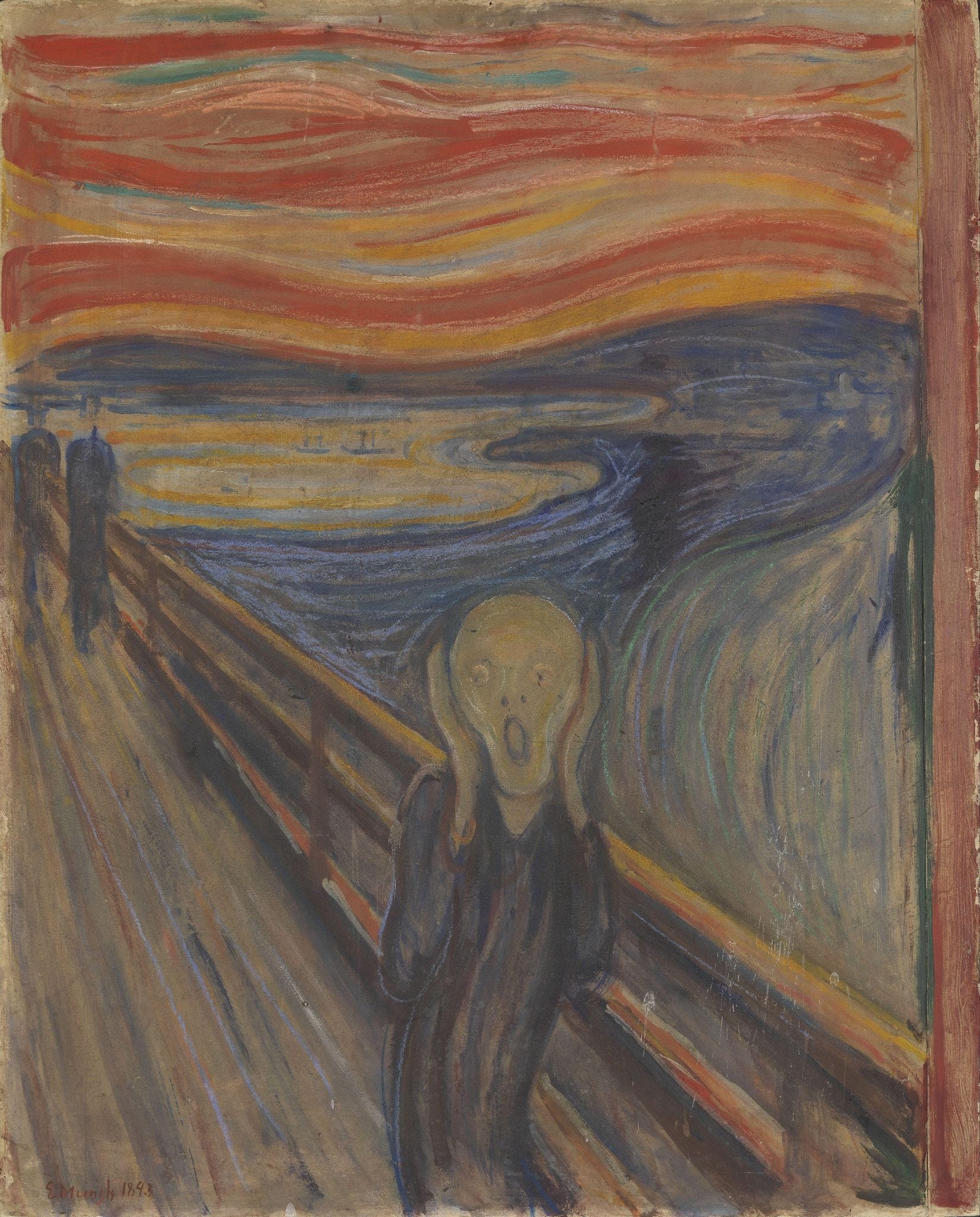
It’s a spooky, gothic, Halloween-inspired week at Mr. Thread’s art department. Enjoy these unsettling images from the public domain. Did you know that the screaming figure in Edvard Munch’s famous piece “The Scream” may have been inspired by the artist’s memory of a hollow-eyed, bound Peruvian mummy on display in Paris at the Musée d’Ethnographie du Trocadéro in 1889?
Enjoying Mr. Thread?
How can we make this better? We read every message and genuinely want to know what you think.