
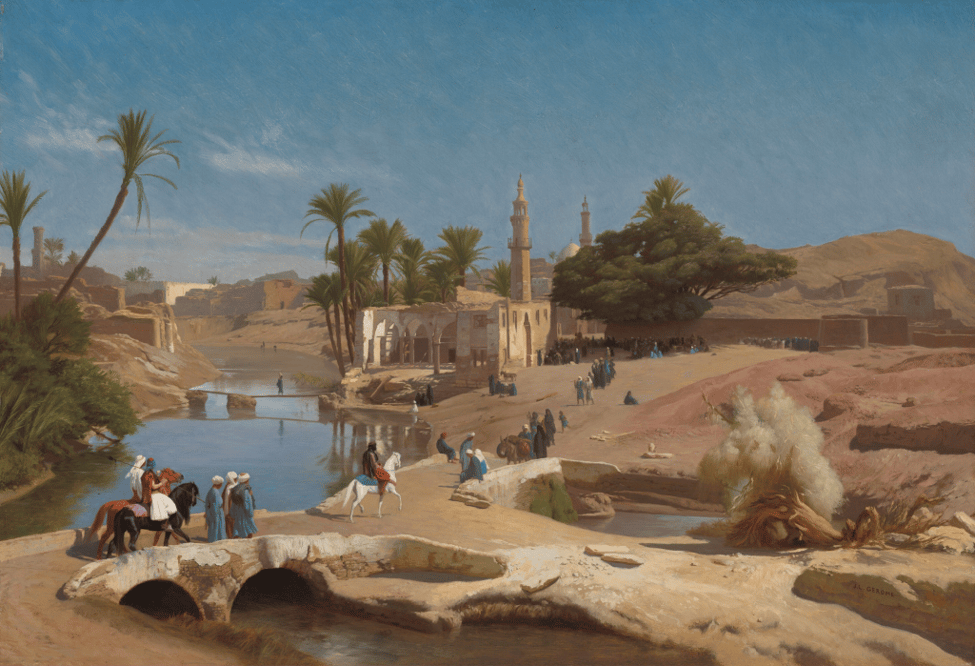
Jean-Léon Gérôme: View of Medinet El-Fayoum
~ In Memoriam ~
Dave Dawson
Dave Dawson was a legend of this industry. In just over twenty-five years he built Urban Electric into an American icon—a company that stands for everything we believe in at Mr. Thread: authenticity, craftsmanship, and serious business sense. He also founded Makers Alliance, a brilliant coalition of American companies devoted to preserving the best of made-in-America manufacturing. He was a friend to the design community, loved and respected by everyone who met him. He was lost far too young, but he leaves behind a legacy that will not be forgotten.
“Dave Dawson started The Makers Alliance, through which we met. Every Maker admired Dave and secretly or openly, we all wanted to be just like him. He wasn’t just a leader—he was our hero, and we loved him. As a Texan, I’ve always thought that when Willie Nelson dies, I’d be at a loss to remember how to tie my shoes. With this news, today, it’s a lot like that, thinking about our lives without Dave in them.”
—Kyle Bunting
Issue #00034: July 2nd, 2026
Hello readers…
We have a scorcher on our hands. Here in North Carolina, it’s 100 degrees but it feels like 117, and I’m loving every minute of it. I’m Egyptian; the desert heat is in my blood, and I’ll take a sticky, blazing afternoon over the constant blast of American air conditioning any day.
My staff in Venice can’t say the same. They’re melting because no one can retrofit air conditioning into ancient palazzos (nor should they). Here’s the thing about Venice in a heat wave: it’s a city of canals, so no matter how rich you are, there’s no cool car to duck into on your way to the next destination. Heat in Venice is a great equalizer.
But in our industry, we follow the heat, and there’s nowhere hotter than the desert right now. Believe me: I’ve been working with an engineering firm sourcing for a private residence in the Far East: 300,000+ square feet, 30 bedrooms, garden galleries, grand halls, barber shops, the works. A modern Versailles set in an arid, sun-scorched landscape.
The interior budget on a single room easily runs in the millions; the chandeliers cost about what a Tesla self-driving car does; the furniture, wallpaper, and fabric alone will land easily over $50 million.
What’s interesting to me is that the buyers in these nouveau riche regions value one thing above all: the brand label. Not the colors, not the 100-year history, not the artisan who hand painted the fabrics, just a famous name they can point to.
My companies have produced work that has hung in the Hermitage, the Met, the US Senate, and the royal palace in Amsterdam, and for this client that list is the entire pitch.
Meanwhile, back home in America—the biggest luxury market on earth—the exact opposite is happening. The American buyer is done with logos. They want meaning, specialness, and a story that means something to them. This week our guest essayist says so in the tale of a broken pair of sunglasses, and a brand-new McKinsey and Business of Fashion study says so in hard numbers. We’ve read all the data, so you don’t have to.
So read on to find out why one industry insider thinks RH is going bankrupt, why craftsmanship stopped closing sales, and how many phalluses you can find in Madonna’s house.
Fair warning: this one’s a monster. If your inbox clips it, read it online—and yes, we’re weighing a move to Substack for the summer, so stay tuned.
See you next week.
Mr. Thread
P.S. Don’t just read—play. We’ve woven a new mystery into this issue in our PLAYTIME segment. 7 Correct Guesses Last Week. Let’s see who has the “eye” to claim the win this time and secure a spot for our grand prize draw. Scroll to the bottom to join the fun.
Industry

Jean-Léon Gérôme: On the Desert
RH and the battle of the beige
RH is the most argued-about name in our business, so let’s start where the fight is loudest. Gary Friedman has launched RH Estates, 165 collections reproducing legends like Michael Taylor, Dennis & Leen, and Dmitriy & Co., wrapped in a 300-page sourcebook and new standalone galleries in Greenwich and West Hollywood. Friedman calls it “removing the barriers that have segregated taste from scale.” Look, it’s a smart move—Taylor’s curves are iconic, and RH has the chops to deliver it. But check out the lookbooks. These rooms are sterile, beige-on-beige, and styled like a showroom for the same reason realtors paint interiors white to ensure a quick sale. What’s missing is the soul. You can copy the exact curve of a Michael Taylor chair and still lose the man entirely. To me, this reads less like a tribute than a name being cashed in.
They also just introduced “a new covenant with the Trade.” After spending a decade declaring our industry the enemy and vowing to take it down, he now sees the light and desperately wants designers back. He’s finally offering financial incentives for designers to shop at RH, among other benefits (though let’s be honest, it’s really about the money). These are moves that are obvious pivots away from strategies that didn’t work. Will designers now take the bait and welcome RH back into their budgets? That remains to be seen.

These launches landed the same week as a bruising quarter for the company: revenue slipped 1.7% to $800 million, hit by roughly $45 million in backorder and special-order problems, and RH posted a $1.97 per-share adjusted loss—though, defiant as ever, Friedman raised full-year guidance. No wonder RH is a lightning rod. A New Jersey shop owner, Elke Ridge, who posts sharp, funny business breakdowns under her Instagram handle, Whimsicality, racks up thousands of comments every time she talks about the stock—proof that nobody in this industry can look away from RH, least of all the people who swear they’re over it.
“It is stagnant. It is big, oversized, beige, beige, beige furniture. And the only people buying it, to be honest, are 40-, 50-, 60-year-old single men. There, I said it, and I'm not sorry about it.”
Cohen strikes back
Two weeks ago Charles Cohen pulled a $187 million rabbit out of a hat and paid off Fortress Investment Group. Now, barely dry, he’s suing them for $204 million. Cohen claims Fortress botched the foreclosure auction of four of his properties, scooping them up for $150 million—$85 million below the lender’s own internal valuation—in a process that, his suit argues, should have used different brokers, different marketing, and different timing. Fortress denies all of it.
Translation: the man who just wrote a nine-figure check to end this war has decided the war was worth reigniting. I’ll keep my commentary measured, because I still lease space in his building and he’s not a man who lets things go. But this one is turning into a soap opera with no happy ending for the world’s most iconic fabric brands.
“The out-of-court auction of the properties was not conducted in a commercially reasonable manner and should have involved different marketing strategies, different brokers, and different time frames.”
Economy

Jean-Léon Gérôme: Prayer in the Desert
Everything you need to know about luxury
Business of Fashion and McKinsey just surveyed more than 2,000 luxury clients across the US and China. We read the 65 pages so you don’t have to. Five things worth your time:
Craftsmanship is no longer the differentiator. It’s all about feeling now. Craft now ranks 9th of 10 desirability drivers in the US and dead last in China. Emotional connection ranks first in both. “We’ve been doing this for 125 years” is not a pitch anymore; it’s all about making the buyer feel like they relate to the product.
Scarcity is losing its spell. Only about a third of US clients and a quarter of Chinese ones say waitlists or limited runs push them to pay full price. People have wised up to that manufactured urgency—the Birkin two-year wait, the long list for a Ferrari, the “only three left in your cart” hocus pocus.
The showroom is king. In China the physical store is the number-one source of inspiration, which is why Louis Vuitton built a boat-shaped Shanghai flagship with a trunk museum and third-floor café. In the US it’s the opposite problem—pushy associates and long queues are pushing clients to resale markets and online. In an AI world where nothing feels real, the room you can walk into and touch is a bigger asset than it has been in years. I’m opening two more showrooms next year for exactly this reason.
Small can beat legacy—but read the map. In the US, 68% of clients say a challenger brand best represents who they are, versus the legacy houses. In China, legacy still rules, with 69% saying they’re drawn to big historic names. I saw it first hand this week with my potential Middle Eastern customers: they wanted to see the label.
If AI can’t find you, you’re toast. You and I knew this back in January. Roughly half of luxury clients now use AI to explore brands and compare products before they ever speak to a human. L’Oréal is already restructuring its content so the machines recommend it correctly. Most design businesses haven’t thought about this at all—our friend Chad Smith at Tradespoke is one of the few building for it.
The Mr. Thread verdict
The thing that stuck out to me while reading this is that luxury clients are more skeptical, more selective, and far less impressed by heritage and craft alone. What they’re buying is meaning. And meaning is exactly what a craft-driven, story-rich business is built to sell—if you tell the story right. The founder of one of my brands lost his father at three and found that making beautiful things was the thing that pulled him out of his own suffering. That beats a designer label any day in my book.
“It sometimes feels like sales associates assume you will buy as soon as you walk in. They’ve lost the art of the soft sell, and that pressure puts me off.”
1st Dibs keeps missing
A fresh analysis has slapped 1stDibs with a sell rating. The numbers don’t lie. Gross merchandise value has fallen from a $459 million peak in 2021 to around $360 million in 2025, first-quarter GMV dropped another 5%, and revenue is still below where it was at IPO. Management has prettied up its margins (the company finally turned cash-flow positive) but only by slashing marketing, which is like dieting by skipping the gym. The world’s greatest collection of antiques sits on a platform that can’t grow. It’s a caution for anyone who thinks a beautiful catalog can market itself.
A billion reasons to follow up on your tariff refund
Buried in the tariff mess is real money. US Customs just expanded its refund process so more furniture importers can claw back duties paid under the IEEPA tariffs the courts struck down—part of what could total up to $175 billion in refunds across the economy. Over in the sportswear world, Nike just said it expects $986 million back, and its latest quarter’s margins were, in one analyst’s words, “highly flattered” by the recovery. If a sneaker giant is banking nearly a billion, it’s worth an afternoon with your customs broker to see what’s owed to you.
A record night for the rich
They say if you want to know what the very top of the market is doing, watch the gavel. A Sotheby’s evening sale in London raised £393.4 million (about $521 million), the house’s biggest-ever night of modern and contemporary art in the city. Joe Lewis—the billionaire former owner of London’s Tottenham Hotspur Football Club—sold twenty-four works for £296.3 million (roughly $392 million). This was a record for any single-owner London sale. All this in a market gutted by Brexit, where UK auction sales had fallen 47% since 2015. Tottenham fans, including Mr. Thread’s West Coast Editor, Mr. Weft, note that the Lewis family has already pumped £100 million into the club this summer—and hope some of it finds a new striker.
“This was a perfect example of what London can do. This was the best sale we’ve had here in years. It showed that if you offer great quality material people will go the extra mile.”
Guest Essay

Meena Dimian: @meenaconsulting
Made in The Shade 🕶️
By Meena Dimian : @meenaconsulting
It’s Saturday night in Hollywood. I’m at the bar at the Musso & Frank Grill on my third gimlet, settling up to stumble into the disgusting dive next door to watch the fourth quarter that I’ve been waiting for the last four decades. The Knicks are down by a few, but seem pretty confident even though it’s an away game. Approaching the massive open-air taqueria I’m passed by a gauntlet of giant fishbowl margaritas that could double as kiddie pools. I’m overdressed. The floor is sticky, the patrons are missing essential body parts (teeth, namely), and everyone’s eyes are glued on the possibility of the first NBA championship for New York since 1973. I tuck my glasses in my breast pocket, I sit at the bar, order a Glenfiddich on the rocks (playing it safe), and wait for the clock to wind down.
The final shot didn’t end the game—the game was essentially over two plays earlier when a few forced errors put San Antonio down by four with seconds left. It was time. Wemby, the seven-and-a-half-foot-tall French alien freak, pops up a hopeless three-pointer that doesn’t even come close. The mark of the defeated. Now, keep in mind, I’m in LA. Half the bar is full of Texans, half the bar are New Yorkers (or at least people who pretend to be from New York—New Jersey, Connecticut people, etc), but even the people who were rooting for The Spurs were wowed by the moment. People were jumping, screaming; one fellow even let a tear out, it was a surreal experience. Arms in the air, we were leaping and hugging uncontrollably, at moments almost violently, it was a long-awaited release.
Driving down Highland Avenue back to my home, I hear people honking, I see people dancing in Knicks jerseys on the corner of Melrose, I’m taking it in as the booze starts to wear off. Back home, I take my jacket off and notice my David Kind frames that I’ve been wearing since 2009 have split in half right down the nose bridge. The one break point that is irreparable, oh, and the other half is totally gone. I guess the joy of the Knicks’ victory was too much for the Japanese acetate to sustain. It’s weird to lose accessories that become part of your identity. I saw the world in those glasses, London, Paris, Venice—all through those lenses. I’m also a believer in destiny, so I felt it might be time for a change, in line with or even against my own will.
Shopping for sunglasses is hell. If you actually care about the way you look and only plan to buy a few pairs in your lifetime, it is almost an impossible feat. The size, the color, the lenses—quality, material, branding, it’s literally endless. There are probably a thousand brands just in America, let alone the tens of thousands in Europe. Let’s not even get into the Japanese, who have mastered the art of making things so beautiful that choosing anything becomes impossible. This is a particularly harrowing dilemma because I have chosen to live my life in two of the most sun-intense spots on the global map. Between South Florida and Los Angeles, my retinas are deep-fried on a daily basis, and these are both driving regions, so visibility is paramount when your car hood is on the brink of melting.
So I visit local boutiques, find some interesting new brands, some iconic ones, all very stylish but slightly off the mark. Too big, too light, too 1970s pornstar. Nothing feels right, and my ocular capacities are dwindling by the day under the golden California sun. I try my luck on Facebook Marketplace, and stumble upon a newly listed pair from Jacques Marie Mage. Highly respected brand, top quality, handmade product. Revered and recommended by a few of my clients and art-world friends—I even had the luck of meeting Jerome Mage himself last year at an event and we chatted about the eyewear industry, and about a mutual friend who used to be one of my dearest clients. He is legit, the product is legit, I’ve got nothing bad to say. The only apprehension is that in the world of eyewear, there has never been a bigger “IT” brand. Basically, Jerome cornered a luxury market by making something so top-tier that if you wore any other brand, you were just announcing to the world that you were poor. Nevertheless, the frames were the right size, right color, and the girl selling them was willing to meet halfway at the most modern hipster coffee bar in Hollywood you could imagine.
I showed up early, I sat with my $6 Americano waiting for her arrival (that’s 80% hot water, by the way). Perched on my aluminum cube, I start scanning the crowd. The Hollywood artist is truly its own breed. Luxury for the unemployed and the unemployable. Guys in weathered leather jackets, girls in athleisure and sweatshirts, pant-less. Again, I’m overdressed. Something did jump out at me, though. Everywhere I seemed to look, I see the gold-fill temples, indicative of the Jacques Marie Mage brand, plastered on the side of most of the patrons’ heads. Young girls, guys too old to be wearing wallet chains, and by God, I even think one of the baristas was wearing a pair as their vision frames. When I first discovered the JMM Instagram account in around 2011 they had 14,000 followers on Instagram. Everyone loved their content, but no one could afford (or justify the expense) to actually purchase a pair for themselves. Fast forward 10 years and one of the extras you glanced at a decade ago on “Desperate Housewives” is sporting a pair of Jaggers at the very reasonable sum of $1,185. I sip on my undeniably delicious coffee, and still can’t help but grimace.
What happens when luxury gets caught up in mass-adoption? If everyone you encounter has access to the same product, is it special? Is it worth it? Most importantly, is it even interesting anymore? Are we shifting into an era where the small-time, under-the-radar brand becomes the most desirable? Is a windfall of praise and positive PR actually damaging otherwise credible brands by rendering them overexposed? It seems after the boomers bought literally everything ever made and filled their second garages to the rafters with Costco junk, the next generation is indeed buying less, and focusing on quality over consumption (which is great news) but abandoning all sense of personal discernment. If the influencers wear it, that’s all the validation they need. Cost, supply chain delays, even poor aesthetics as they relate to them personally, will not hinder them from lining up and shelling out thousands for the validation of everyone around them knowing what they paid for their shades. Simply because everyone in the room just bought the same pair last month.
She showed up, patiently watched me stare into my phone screen, audibly talking myself out of them. I didn’t buy the frames. Not because I don’t like the brand, or didn’t think they looked good…I do, and they did. I didn’t buy them because I felt like they have been bought to death. JMM didn’t need me as a customer. They don’t need anyone. Jerome Mage has built an empire on a product that everyone truly wants, and seemingly has. In the culture shift we’re going through, people are craving human connection, a reason to chat about something, share perspectives, tell stories. In my experience, there is no better impetus to that conversation than “Hey, where’d you get that?” Every new discovery is an opportunity to share. Share your experience, your style, your choices…to inspire each other. Mass adoption is the death of all that, and I can’t be part of it.
It’s time to return to the magic of discovery. Walking down an old alleyway in Florence, or by a tiny workshop on the Lower East Side and finding someone who is actually making something. Something unique, made in small batches with care, and maybe even an imperfection, so it’s truly yours. Here’s hoping I find that before the Knicks win their next championship. Until then, I’ll be here, driving down Venice Blvd., squinting.
Opportunities

Jean-Léon Gérôme: Rider and his Steed in the Desert
A eulogy for the influencer
Drew Michael Scott has built a real business out of YouTube—1.78 million subscribers on his Lone Fox channel, another 1.5 million on Instagram, a brick-and-mortar shop, and a refreshing habit of editing every video himself.
On the Business of Home podcast, he drops genuinely useful advice, including one that really speaks to me at the moment: long-form beats short-form for building trust (you’re with someone 10 to 20 minutes, not 20 seconds). TikTok will bury you on a whim—he has 1.5 million followers there and a post can die at 1,400 views. It’s smart stuff and it speaks to why I’m not bullish on the influencer era. It gets harder every month—the platforms hold all the cards, and I suspect only LinkedIn survives the decade (no, I’m not kidding). The real opportunity is finding a way to build something so good people come find you.
Loose Threads
Trump’s “Patriot Passport” hides the Declaration of Independence behind his own scowling face.
Tour Madonna’s home: the decor is gloriously unhinged, and there are perhaps a larger ‘collection of cocks’ than you would expect.
World of Interiors goes inside Frida Kahlo’s (Madonna’s favorite artist) cobalt-blue Casa Azul—luscious proof a home can be an artist's greatest work.
Rick Owens and Adidas made inflatable tracksuits with built-in fans—heat-wave couture so absurd my Venice team wants a set.
Playtime
Shout out to Hillary E., Tullia P., Martin R., Ginger S., Freddy V., Avner L., and Rico V., who identified last week’s mystery word correctly: SCALLOP! Keep it up, threaders!
Smart enough to guess this week’s mystery word, threaders? It’s playtime!
The Clue: Dior’s iconic mens’ fragrance of the late 1980s.

Piece together the mystery word based on the clue provided above.
Click HERE to submit your answer.
Type your answer in the subject field and hit send!
The Stakes: Every correct guess earns you points that accumulate for our upcoming raffle. The more you play, the higher your chances of winning. We’ll be holding the grand draw on July 29th! Our lucky winner gets:
A featured spotlight for you/your firm in an upcoming issue of Mr. Thread.
Another special mystery gift from yours truly, Mr. Needle.
Stay sharp,
Mr. Needle
This week’s art

Jean-Léon Gérôme: Self Portrait
I stumbled onto Jean-Léon Gérôme while searching for art capturing the heat of desert life. And if you know anything about me by now, you know I love the heat. So it doesn’t take much for me to picture myself inside these scenes. Desert life has always held some pull on me, and Gérôme's paintings put me right there.
Fun fact: his most famous work, “Pollice Verso,” a painting of Roman spectators giving a gladiator the thumbs-down, is the painting that convinced Ridley Scott to direct Gladiator. Scott saw a reproduction and said it captured the glory and wickedness of Rome in a single image.
Glad I found him. Hope you enjoyed his work as much as I did.

Jean-Léon Gérôme: Pollice Verso
Enjoying Mr. Thread?
How can we make this better? Reply to this email and tell us. We read every message and genuinely want to know what you think.