
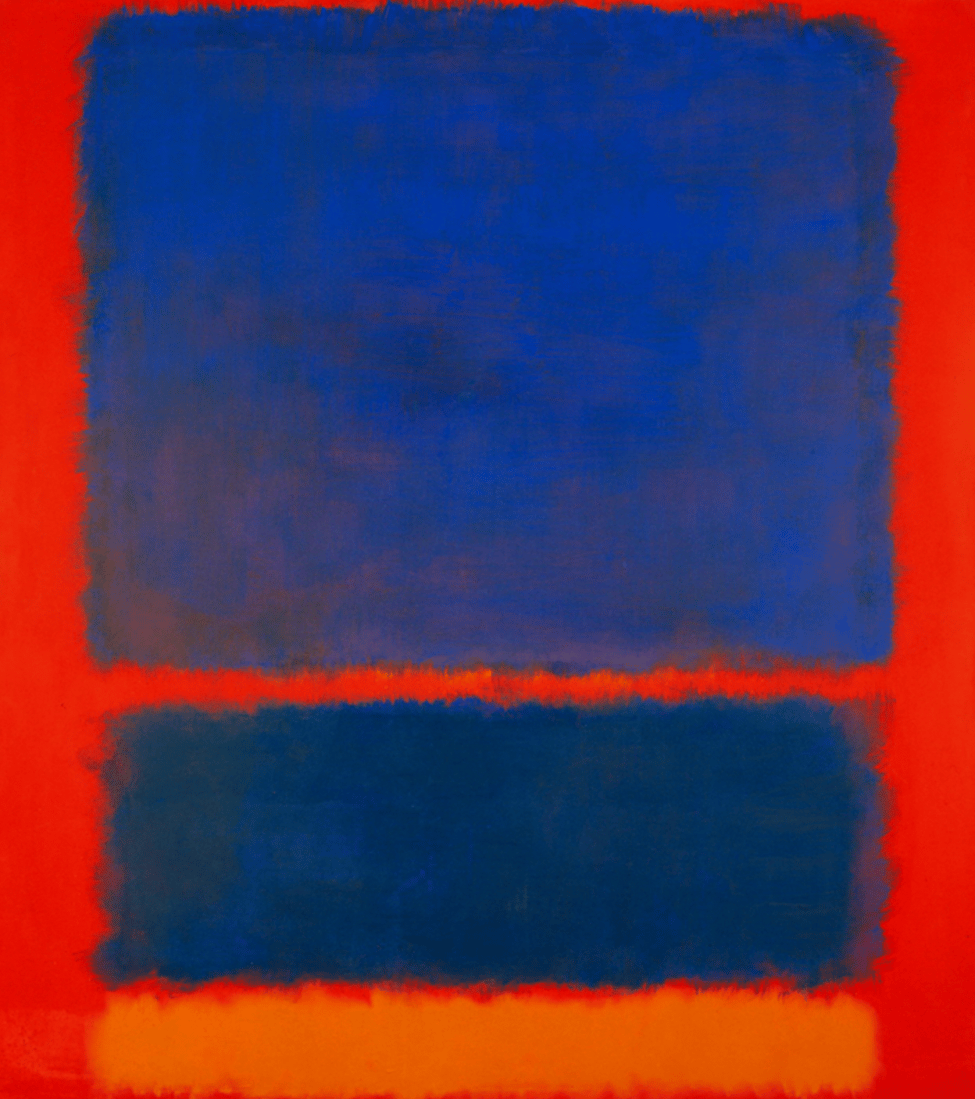
Mark Rothko: Blue, Orange, Red
Issue #00032: June 18th, 2026 - Go Knicks 🏆
Hello readers…
Three years ago I ran a contest at my company with a cash prize: drop our fabrics into Midjourney and show me the most creative interior you could dream up using our fabrics. These were the clumsy early days—you had to write prompts through Discord, and I made little screen-share videos teaching people how. I run a 100-year-old fabric company that existed before the telephone, so I was surprised when all most of my staff jumped in with both feet, from the CFO to the fabric painters. It was a revelation, and I’ve been encouraging my team to keep learning AI ever since. But not to replace our humanity, only to elevate it.
I'll be honest. If AI vanished from my personal life, I'd survive—search would get harder, I'd have to change my own thermostat and write my own greeting cards. But if it vanished from my business, I'd feel crippled. People keep warning me the bill is coming, that they're selling us cheap tokens to get us hooked. It's working. I've slowed hiring because my existing team is simply more capable. We are more productive than ever, and the real win is, it is has made our work more fun. The mundane is now handled by AI, which lets us focus on the things that inspire us and bring out our real talents.
For all the doom surrounding AI, I am on the opposite side of the spectrum. Used for good, I am convinced it will lead us to the next great human Renaissance.
So here are the top seven ways I use AI to grow my business, make my job more enjoyable, and increase my productivity 100x:
My brainstorming co-pilot. Being a CEO is a lonely job. AI is the companion I think out loud with—then it does the heavy lifting, vetting luxury packaging vendors, building customer personas, and even helping me hunt down the art and artists for this newsletter.
My infinitely powerful data analyst. Before I fly out to meet my California sales reps, I ask what's moving—colors, order sizes, zip codes outperforming the rest. It surfaces trends I used to hunt by hand, half of which I'd never have spotted. (I still verify the numbers myself until NetSuite catches up.)
My HR department. A full training module used to mean hiring an agency like McKinsey, a copywriter, and a graphic designer—an expensive, three-month job. Review meetings, employee handbooks, job descriptions… all that used to take forever. My CFO now drafts them in-house in a fraction of the time. We add our context and edit, but the heavy lift is gone.
My in-house headhunter. The prospecting that once had me researching candidate after candidate until my eyes bled is far tighter now. I tell it exactly what I want, and it delivers—which is a big reason I've been able to slow hiring without slowing down the business.
My super project manager. We still run on Slack, email, and Loop. But AI now reads across all of it and surfaces what needs a nudge, e.g. “Your marketing director hasn't delivered the documents—check in with her.” It's like having a full-blown project manager at my side, so I'm not chasing people around.
My resident graphic designer. Our price list once lived in messy, slow Excel for years. Now it's a beautiful, searchable, sortable site the whole sales team can access online. Same story for client and partner presentations—polished in minutes, not days.
My market researcher. Trend analysis that took a digital marketer several days now runs in seconds—simple enough that my 14-year-old could pull it. Add A/B testing and distribution across every channel, and the marketing grind is mostly handled.
Which brings me to something we just built: a trends dashboard for our world. Feed it a keyword—“velvet,” “alpaca”—and it goes hunting across Google Trends, YouTube, Reddit, and Pinterest, then back into your own site to show you the opportunity. Think Bloomberg terminal, for interiors. There's a poll at the bottom of today's issue. If enough of you say yes, we'll build it out for you.
The rest of this week is all about AI—and the people figuring it out fastest.
See you next week.
Mr. Thread
P.S. Don’t just read—play. We’ve woven a new mystery word into this issue in our PLAYTIME segment. Let’s see who has the “eye” to claim the win this time and secure a spot for our grand prize draw. Scroll to the bottom to join the fun.
Sit down with Mr. Thread

Guy Ailion
Guy Ailion
Guy Ailion spent two decades as a London architect before noticing that interior designers — the most visually exacting professionals alive — were choosing their materials not because they were the best option, but because the samples were already on their desk. He left his partnership, co-founded MattoBoard, and built a platform that gives designers access to thousands of digital materials without anyone couriering a swatch. Home Depot Ventures and Masco backed it. Last year, Ailion also published MattoBoard's inaugural State of AI & Business of Interiors report — a survey of 250-plus designers across six continents — which found that 81 percent of designers now use AI regularly, and most of them are anxious about it. The top concern: that AI will make everything look the same.
Q/A
Things move fast in AI. What have you noticed since the report came out?
We're still in a liquid stage where no fundamental changes in workflow have solidified — but that doesn't mean we're not in a transition. In our industry, mistakes get more costly the further down the workflow you go. If you specify the wrong material for a hotel foyer, that's an expensive error. So the further you go into the process, the less AI has permeated, because the stakes are high and trust hasn't been established yet. But at the early stages — visualization, inspiration, experimentation — AI is extremely well adopted.
The bigger shift I'm seeing is this: traditionally, designers had to do all the drafting work upfront just to produce a visualization that would get a client to sign off. That's enormously labor-intensive. What's happening now is that the cost of visualization is being driven down to basically zero. So designers can show clients a rendered idea at the very beginning, before any drafting happens, get their feedback, and only then commit the labor. You do a lot less repetition. You're not remodeling everything from scratch every time a client changes their mind.
Do clients now expect to see AI renders upfront?
I wouldn't phrase it that way. Clients have always wanted to see visualizations — that's why Pinterest became so popular, because it gave designers a digital shortcut to show clients a direction. Clients respond to pictures, not words. That desire has always been there. What AI changes is that the designer no longer has to delay that moment. Previously you'd show a client a Pinterest image and say, “Just imagine this in your room.” Now you can actually show them their room, in that style, right at the start, before you've done any drafting at all.
The sourcing gap was one of the most striking findings in the report — 93% of designers are spending up to 20 hours a week on material sourcing, but only 35% trust AI to help. Is that the problem MattoBoard is built to solve?
Exactly. MattoBoard is a virtual sampling and visual curation platform. We have a digital library of materials and products for interior projects. A designer can bring their own visualization, or something they found, or generate one directly on MattoBoard — and we break that image down into the materials and products that create that look, matched to their specific brief. Is it a wet room? Residential? Based in New York? Do they need expensive materials, or would engineered flooring work? We can parse all of that. And we don't just match the aesthetic — we map the product data too. Slip resistance, fire ratings, regional availability. We find materials that are beautiful and specifiable.
“The studio of the future is part human, part machine — and the human is the conductor.”
There are probably infinite options for engineered hardwood flooring. How does the AI decide?
We have around 50,000 materials and another 50,000 furniture pieces in the database. But we always give designers options — designers love options, that's not going away. If someone writes “mid-century modern kitchen,” we understand they're probably not looking for light oak, maybe something with more of a matte finish. If they've specified a tighter budget, we might suggest engineered board or tile instead of natural wood. We read the brief and provide a curated range of the best visual fits.
Can designers get a full rendering inside MattoBoard?
Yes. They can type in a brief and we'll build an image of that design with materials applied. Or they can bring their own image, and we'll break it down and offer alternative materials matched by color and texture. And with our editing tool, they can swap materials in and out of an image directly.
Why did you become such an early adopter when so much of the industry is anxious?
I ran an award-winning practice in London doing ultra-high-net-worth and celebrity homes. And the decision bottleneck on every single project was always the same two things: the paradox of choice — too many options for both the designer and the client — and the time it took to produce visualizations that could bring clients to a decision. Everything was some form of visual presentation: material boards, mood boards, renderings.
When I started seeing that AI could reason across complicated data — and technical specs for the materials industry are just mountains of PDFs — and also produce visualizations, I thought: there's an overlap here. For the first time, you could search for materials and see them rendered simultaneously. We've never been able to do that. Previously you'd search across dozens of websites, order samples, file them, compile everything in a presentation, design somewhere else. This idea of looking for products and seeing them appear in front of you in context — that's the fastest way for a designer to think creatively. When experimentation becomes cheap, creativity becomes freer. Instead of it taking hours to try five different materials, you can try twenty, quickly.
Why do you think so many designers are still anxious about adopting AI?
I think designers are more scared of losing the steering wheel than they are of AI itself. When they see AI produce something beautiful, they feel slightly disenfranchised. But what I keep coming back to is this: the job shifts from producing content to selecting the right content. And honestly, selection has always been the job. People don't hire designers for their technical ability alone — they hire them for their editorial eye. Knowing what pairs with what. Knowing where to take a risk. AI is going to amplify that skill, not replace it. We are curators, connectors, placemakers. Once designers realize that, they can see AI as a tool to help them select more, faster, better.
The other part is trust. AI makes errors. And the further you go into the workflow, the higher the stakes, and the more trust you need. Nobody has proven themselves as the right tool for those later stages yet.
“We are curators, connectors, placemakers. Once designers realize that, they can see AI as a tool to help them select more, faster, better.”
Is the fear of everything looking the same warranted?
Yes — and it's structural. These models are probabilistic machines. They absorb as much input as possible and calculate the most probable successful outcome. And that will always be the mean of the bell curve. If you use default AI, you get the average. Your outputs soften toward the mean. You become very average.
Now, that's not entirely bad. Most clients actually like the average — the average can be beautiful. But designers and artists live at the edges. Innovation happens at the edges. And the edge is always evolving: someone pushes into new territory, it gets popular, it moves toward the mean, and the next innovators are already somewhere else.
The challenge is that AI, as it's currently deployed, makes the mean very easy to reach. It's up to the designer to push against that. At MattoBoard, we've actually built our generative model to resist the default — to push toward edge-case, unexpected combinations, happy accidents. We think about that a lot.
Where will we be in five years?
The stages of architecture and design don't disappear — the deliverables will always be contractually required. But the labor between those stages evaporates. We've already seen rendering go from weeks to seconds and essentially free. What I think becomes the irreducible human moment in the workflow is the decision itself.
We will always be the custodians of decision-making. And that comes back to the same idea: selection is our ultimate skill. The studio of the future is part human, part machine — and the human is the conductor. The decision-making bottleneck. I use that word as a term of endearment. It's where our value lives.
LEARN MORE: Visit MattoBoard, and Guy Ailion’s architecture firm, KSR Architects. Guy also writes about small ideas with huge impact on design and psychology at smallhuge.com.
📊 AI AND INTERIOR DESIGN BY THE NUMBERS
81% use AI regularly. Most of them are anxious about it.
93% of designers spend up to 20 hours a week sourcing materials — yet only 35% trust AI to help.
85% use ChatGPT. A text chatbot is the dominant tool in one of the world's most visual professions.
57% fear AI will make every interior look the same.
82% believe AI literacy will be essential within two years.
Source: MattoBoard Interior Design Report
Musings from Mr. Weft
Mr. Weft is Mr. Thread’s West Coast Editor and Correspondent, based in Los Angeles.
AI-powered lighting websites are a turn-off
I’ve been renovating my kitchen in California, which meant I needed lights—two pendants for an island, a chandelier, and a pair of sconces. Not in a position to hire a designer, I did what most people do: I went online.
What I found there was something new. Websites with slightly Scandinavian-sounding names—Vakkerlight, Ozark, that sort of thing—selling beautiful fixtures at prices that weren’t cheap but weren’t suspicious. The photography was immaculate, the copy restrained and confident. I placed my orders.
Six weeks later, the boxes arrived…on a boat from China.
The electrical fittings were 3D-printed from cheap plastic. What the site called “natural wood” was pressed metal with a wood-grain sticker on top. One pendant hadn’t come at all. The chandelier ($400) looked like something from a dollar store. The return policy was theoretical—complaints were met with silence, or offers of partial refunds. Shipping everything back to China would cost more than the lights.
American Express sorted it out. They’ve seen this before.
Vakkerlight, it turned out, was a drop-shipping operation that took my order, forwarded it to a factory at maybe $20 a unit, and kept the difference. It was an entirely AI-powered enterprise, probably run out of someone’s basement. You see, a convincing e-commerce site once required a developer, a designer, a copywriter, and several weeks. Now anyone can do it with a free account and a few hours. The barrier is gone, and the money is good enough that it doesn’t matter if half your customers dispute the charge.
I’ve worked in e-commerce for a decade, and I’m not easily fooled. I’m also not the only one fighting back. On a podcast called How I AI, two women are building AI shopping assistants—not tools that find you the best product, but tools that investigate the seller. They read the thousand reviews you’d never have time for, check whether a company has a physical address, and spot a drop-shipper before a dollar changes hands.
So the drop-shippers outsource their web design to AI. Shoppers, it turns out, are outsourcing their shopping to the same robots. Soon the marketplace will just be robots talking to robots, and we humans can just sit it out.
In the end I drove to a local showroom, where I could hold each fixture in my hands. The salesman worked out the price with an old-fashioned calculator and a handshake. The new lights arrived last week. They look wonderful. Sometimes the old ways are best.
🏀 Beauty for the win
Mr. Thread is the work of a four-person team driven by a single mission: help a creative industry do better business, make more beauty, and leave the world a little better for it. That’s it.
If you know a colleague or designer who'd benefit from our weekly journal, we'd love it if you shared the link below.
We appreciate you!
AI Loose Threads
“AI money” and the K-shaped housing market
Real estate agents have a new phrase for the luxury boom: “AI money.” Axios reports luxury home prices hit a $1.39 million median, up 3.6%, while non-luxury managed just 1.4%. In the Bay Area, luxury homes are up 13.4% since ChatGPT launched; affordable homes are down 3.8%. My takeaway: follow the AI money. It’s about to start renovating houses.
Label the machine
Dezeen says design fairs need an AI disclosure policy now, and it’s right. Milan was the watershed. AI-assisted presentations slipped onto the floor with no label. If the Louvre can disclose its AR and Augusta National can ban cellphones, Salone can manage a tag that reads “made with a machine.” This is about honesty, not hostility to AI. Honesty protects the designers doing the real work. Disclosure is coming. The industry should write the rule before a regulator writes it for them.
The search bar grows opinions
At its I/O conference, Google rolled out what it calls the biggest search overhaul in 25 years: conversational AI Overviews and a universal shopping cart that hunts for deals across merchants. Amazon’s “Alexa for Shopping” is now the default for US users. Most people start a product hunt on Google or Amazon, and those searches now surface whatever the model ranks first. Everything below it vanishes. My takeaway: if your product line isn’t optimized for generative search, you’re toast.
Read more: The Business of Fashion
The robot picks up the chisel
Designboom maps a shift: architects from Bjarke Ingels Group to Rotterdam’s Studio RAP are using robots, CNC mills, and large-scale 3D printing to extend craft rather than erase it. Michael Hansmeyer’s Tor Alva, the world’s tallest 3D-printed concrete tower, proves the point. Once the algorithm exists, an ornate component costs barely more than a plain one, inverting the centuries-old math that pushed design toward simplification. Complexity is about to get cheap, and that’s good news for anyone selling craft.
Google Lens at the estate sale
Business of Home reports the antique trade has fully absorbed Google Lens — dealers and shoppers alike now point a phone at every piece to identify it and ballpark a price. Dealers and shoppers now point a phone at a piece to identify it and ballpark a price. The catch is that those comps come from 1stDibs and Chairish asking prices, which dealer Adam Hoover calls “fantasy numbers,” and they’re inflating what sellers expect. The tool also dulls connoisseurship, since the catalog now lives in the phone instead of the head.
Mind the road, not the wheel
For Monocle, Andrew Leigh offers the long view: the wheel only took off where societies built roads for it, and writing began as accounting before it carried literature. AI is the same. It runs on infrastructure already built and stalls until the next piece arrives, from reliable energy to trusted rules. The lesson, in his phrase, is not to put the cart before the horse. My takeaway: the designers panicking about AI today are judging the wheel before the road is paved. Build the road.
UNESCO does the math
The hand-wringing over AI and creative work now has hard figures. UNESCO’s latest Re|Shaping Policies for Creativity report projects music creators could lose 24% of revenue and the audiovisual sector 21% by 2028 as AI-generated content floods the market. It also flags a widening digital divide: 67% of people in wealthy countries have essential digital skills versus 28% in developing ones. Watch these numbers. They’re the early warning for our industry.
Read more: UN News
ASID calls it: disruption is the new normal
ASID’s 80-page 2026 Trends Outlook, fronted by CEO Khoi Vo, lands on a blunt thesis: disruption is permanent, and designers are the ones equipped to handle it. On AI, the report is past the debate. It’s “absolutely fundamental now, no longer experimental,” and it’s pushing designers from ideation to curation, designers make the calls instead of generating the options. “Creativity is shifting from ideation to curation” is the line to remember. The job survives, and the designer becomes the editor.
Read more: Interior Design
The AIA builds AI a stage
The AIA Conference in San Diego (June 10–13) added its first AI Summit track. Dezeen co-CEO Benedict Hobson joined a panel called “The Productive Architect” alongside SketchUp and Perkins Eastman. When the biggest professional body in American architecture hands AI its own room, the should-we debate is finished.
Read more at Architectural Record.
Playtime
And the crowd goes wild! A massive round of applause for Chad S., Caroline P., Parker W., Martin R., Hillary E., Freddy V., Justine B., Anne-Marie F., Lori L., and Tullia P. who just walked away with the title for cracking last week’s mystery word: VOCATION. Your energy is absolutely unmatched, threaders!
But don’t get too comfortable—our next big challenge is live! Can you spot the hidden mystery word and claim the glory this time? Let’s play!"
The Clue: The hidden recipe of code that translates a designer’s text prompt into a photorealistic rendering.

Piece together the mystery word based on the clue provided above.
Click HERE to submit your answer.
Type your answer in the subject field and hit send!
The Stakes: Every correct guess earns you points that accumulate for our upcoming raffle. The more you play, the higher your chances of winning. We’ll be holding the grand draw on July 29th! Our lucky winner gets:
A featured spotlight for you/your firm in an upcoming issue of Mr. Thread.
Another special mystery gift from yours truly, Mr. Needle.
Stay sharp,
Mr. Needle
Enjoying Mr. Thread?
How can we make this better? Reply to this email and tell us. We read every message and genuinely want to know what you think.