
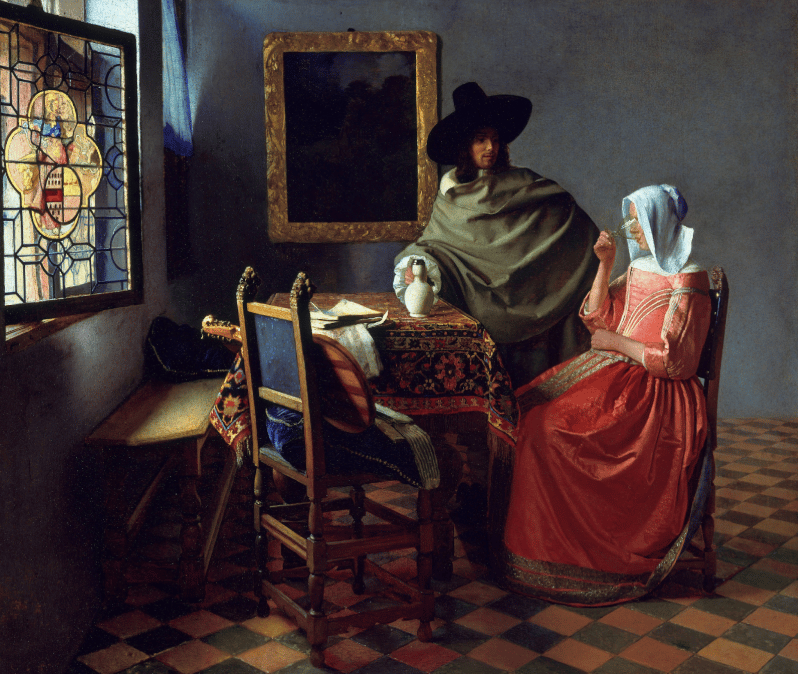
Jan Vermeer van Delft: The Glass of Wine
Issue ##00019: March 19, 2026
Hello readers,
I’m writing to you from a hotel in West Hollywood, getting ready to meet Mr. Thread’s West Coast editor, Mr. Weft, for the first time. I just looked out my window and was struck by a glare of red light like Kramer getting hit with the Kenny Rogers Roasters neon sign in Seinfeld. It’s the Pacific Design Center, one of two design centers owned by Charles Cohen, who has six weeks to come up with $135 million or lose everything. I’d rather be anyone but him right now. More on him in a moment.
I’ve been in Miami and Los Angeles this week meeting with designers, visiting showrooms, and doing what I love most—listening to what’s going on in our world. And I keep coming back to the same theme: opportunity is everywhere right now, if you have the eyes for it. The art market just posted $59.6 billion in global sales. Luxury real estate is booming. The wealthiest Americans have more money than ever. And yet the housing market is frozen, luxury stocks are getting hammered, and 74% of Americans can’t stand AI.
It’s a K-shaped world. The top is flying. The bottom is stuck. For most creative businesses, that means you’ve got to sell to the top, or get super creative to survive.
In Miami I jumped in an Uber, and my driver told me something that sparked an idea for our readers. He wasn’t a regular driver—he was driving a $150,000 car and doing Uber to meet people and find business opportunities. We started talking about textiles, and he told me he’d made serious money through government contracts. He introduced me to sam.gov, a website where the US government posts open contracts for everything from hospital curtains to textiles for tank seats. I spent two minutes on it and found the Air Force looking for case goods for their headquarters in Germany and the Army Corps of Engineers sourcing furniture for new classrooms. There are fortunes being made on this site and it certainly has captured my attention. More on that below.
The spirit of this week’s issue is the human Renaissance. People are pushing back against the algorithm, rejecting enshittification in favor of rebeautification. There it is. Mr. Thread just coined our first word.
Read on to find out why Uncle Sam spent $12,000 on fruit basket stands, who has five aquariums in their Beverly Hills mansion, and why Florida’s lifeguard towers are a design disgrace.
See you next week.
Mr. Thread
P.S. Scroll to the bottom for PLAYTIME—our weekly puzzle game. Last week's Common Thread: MACHINE. Congratulations to Chad S., Sophia K., and Marco F.—you cracked it. Nice try but no cigar to Mia R., Parker W., and Cathy C. Better luck this week, Threaders.
Industry

Hans Holbein the Younger: The Ambassadors
Shelter magazines are back
I just read some great news in this piece by The New York Times about the resurgence of interior design magazines. I didn’t expect this. I thought the shelter magazine business model was getting crushed. I thought the internet had all but killed them off.
There’s something about print that a screen will never replicate. As much as I research the web for Mr. Thread, it’s the shelter magazines I love to sit down with and really absorb. The pictures, the paper, the weight of it in your hands. Cabana magazine deliciously wraps its cover in fabric. These are objects you want to make sweet love to.
Sorry, back to business…
The takeaway for brand owners: reconsider your print advertising. We’ve all been chasing digital funnels and attribution models, and if shelter magazines are surging, there’s an audience we’ve been ignoring. And in my opinion, it is the more beautiful medium for showing the beauty we create, instead of that wretched little device that has become a permanent extension of our hands.
Denver leads the way on design centers
I've never been more energized and more bullish about the industry than I am now. My optimism for us all knows no limits. I genuinely believe we’re at the dawn of a new Golden Age of Design.
The Denver Design District is undergoing a major transformation under the awesome leadership of Amy Gagliana, reports Business of Home. The center is expanding from 45 to 55 showrooms, adding a bakery café, a restaurant, and opening its doors to the public. Phillip Jeffries and Verellen just opened showrooms. Romo, one of the big fish of textiles, is coming soon.
Amy is a star in our industry, and she won’t mind me telling you that she was an early Mr. Thread subscriber. I met her in Paris at PDO. We love what she’s building. Denver is showing that the future of design centers is open, experiential neighborhoods where designers and the public coexist.
I wish someone could bring this energy to other iconic design centers. Speaking of which…
Charles Cohen has six weeks
A court has granted Fortress Investment Group’s motion to appoint a receiver to oversee the sale of Charles Cohen’s properties—including the Decoration & Design Building in New York and the Pacific Design Center in Los Angeles—with a 45-day deadline to recover $135 million in outstanding debt. Cohen’s design center portfolio is down to two buildings after losing the Decorative Center Houston. He’s on the ropes.
This is personal. My brand has had a showroom in the D&D Building for 60 years. As I mentioned, I’m looking at the Pacific Design Center from my hotel window as I write this. And I have a million questions, and feel a little queasy with all this uncertaintity. If their heads aren’t stuck in the sand, many of my fellow tenants surely must be feeling the same.
We need answers, and Mr Thread is going to try and help get them. Stay tuned.
Virtual try-on is coming for interiors
Nvidia and Antoine Arnault (son of LVMH billionaire Bernard Arnault) have invested in Catches, a startup building physics-based virtual try-on technology called RealFit. Before now, most virtual try-on tools were kinda terrible:
"It's just painting an image onto an image. It doesn't have any knowledge of all the important stuff, the draping, the textures, the cut."
RealFit simulates how fabric actually drapes, moves, and fits on a real body. And this technology is coming for our world next. Imagine showing a client exactly how a curtain would drape in their living room before they spend $50,000. We’re always second to the fashion industry on tech, and AI is helping narrow the gap. Get ready for this.
Beauty at the Oscars
Conan O’Brien hosted the Oscars this weekend and I was blown away by the stage design. Misty Buckley and Alana Billingsley created an incredible leafy courtyard garden. And Conan left us with a line for the ages:
“Every film we salute is the product of thousands of people speaking different languages, working hard to make something of beauty. We pay tribute tonight to the ideals of global artistry, collaboration, patience, resilience, and that rarest of qualities today—optimism.”
Bravo! Best way to keep optimism in our lives, and beauty at the center of what we do, is to keep politics out of it!
Silicon Valley takes on custom rugs
Business of Home’s Fred Nicolaus reports that Ernesta, the custom rug startup founded by Peloton’s John Foley, just raised $20 million in Series B funding, bringing total investment to $57.5 million. The company has doubled revenue year over year and plans to grow from six showrooms to 30 by the end of 2027. That’s a lot of rugs.
I spent time on their website this week. The product is solid—hand-loomed rugs made in India, custom-cut to any size, delivered in as little as two weeks. The UX is excellent. Even my mom in Florida could use this for her oddly shaped apartment. They started as direct-to-consumer and quickly pivoted to trade—because, as every rug company discovers, designers command the budgets.
This is a case study in doing custom well at scale. People have been saying forever that you can’t do custom in our industry. Ernesta is trying to prove them wrong.
From the mind of…

Kyle Bunting is the founder of the eponymous Austin-based studio that pioneered decorative hide rugs over two decades ago. What started as a childhood connection to hide has grown into an operation spanning more than a million square feet of rugs, wall coverings, art, and wool and silk carpets.
What does a typical day look like for you?
When you love what you’re doing, you’ll never work a day in your life. That cliché has never been more true for anybody I know than it has been for me. I work all the time and relentlessly, and I’ve never felt the difference. But what’s happening right now is like a second wind, a sugar high, being driven by the renewed potential for the creative-maker-artist that’s being ushered in through AI. It’s almost been like a can’t stop, can’t sleep, can’t stop thinking, can’t stop dreaming moment that is making me, and I hope my colleagues, feel like every day is Christmas Eve.
How are you feeling about the tariff situation?
My business realized this wasn’t about us, but more about how we’d react, and how that reaction would make our clients feel. So the only statement we issued was direct and succinct: my tariffs are not your problem. We absorbed everything. And used it as a moment to improve. We became better manufacturers, more efficient, faster, and we listened more carefully to our clients, their needs, and what it would take to help them be more successful. The result: growth with nominal economic impact. We used it as an opportunity to sharpen our steel and improve the business.
Full disclosure, my exposure was light, as most of our work is made here in Austin. But I saw people play the tariff card to raise prices and take advantage of the situation, which was a disappointment. And I saw others send emails announcing pricing changes that were really just passive-aggressive shots at the administration. Like most things, significant change and challenges will bring out the best and the worst of people. But everything does, doesn’t it?
What did you make of [custom rug maker] Ernesta raising $20 million?
I’m neutral with no bias on how a good idea, or even a bad idea, finances itself into existence. There’s no magic or romance on bootstrap versus private equity. Who cares? I don’t think the consumer or the trade ever even thought about where the financing behind what was possible from that brand ever came from. The question itself is a mystery to me.
Natural materials are having a moment. Is the market finally catching up to what you’ve been doing for 24 years?
I think younger designers are more sustainability-minded. Something more natural and tactile for environments that can bring a respite from everything that might feel produced around them makes sense. For us, our vertical business—art and wall coverings—has exploded in the last 36 months because we’ve entered non-residential segments: hospitality, workplace, retail, etc. At the same time, hide was a limiting factor in residential because somebody would look at a whole house and place what we did in one or two showcase locations. Our wool and silk program addressed the limitation and was built on our ability to do custom from a couture point of view. The fact that our expanded portfolio can go into new and unique environments has been the key to fundamental scale.
What’s the number one mistake consumers make when buying a rug?
They don’t give enough coverage for nesting the chairs on a round rug. They’ll measure the top of the table and say, oh, it’s a five-foot round table, a seven-foot round rug sounds great. Then the chairs are hanging off the edge of the rug. The other mistake is they assume everything comes in standard sizes. What do you have, a 9 by 12? Sounds great, I’ll buy. They assume, and don’t grasp the essence of “made to order.” Designers, through experience, and sometimes error, know these old tricks. That’s one of a million reasons why the TRADE matters and why designers are comfortable owning the liability of ordering the right thing for their clients.
Best restaurant in Austin?
Jeffrey’s [1204 W Lynn St]. No question. Corner table in the bar, fried oysters, bucatini, a Caesar, perhaps the soufflé if I'm in the mood. Especially on a Sunday when bottles of wine are half price.
The color you’re most excited about in 2026?
If I think it, and I see it, I want it—Paint It Black.
What trend are you done with?
Large-scale glass entry doors. Every time I pass anything that’s been developed in the last 10 years and I can see straight through the home, I keep thinking, that’s going to be regretted one day. Feels like a “remember when that was all the rage” moment is near.
Last thing you bought for your home that you’re excited about?
Gary McQueen's Kintsugi Skull, 3rd of 50. It’s fantastic. And Gary, by the way, I still can’t get the lighting right—please come back to Austin.
Any parting shot?
I’ve never been more energized and more bullish about the industry than I am now. My optimism for us all knows no limits. I genuinely believe we’re at the dawn of a new Golden Age of Design.
Economy

Jan Vermeer: The Art of Painting
The art market bounces back—for the rich
ArtNews reports that the global art market hit $59.6 billion in 2025, according to the Art Basel and UBS Art Market Report—a 4% increase that snaps a two-year slide. The recovery is lopsided. Auction sales of works priced above $10 million jumped nearly 40%, while dealer sales grew just 2%. The middle of the market barely moved.
This is the K-shaped economy I was talking about earlier. The ultra-wealthy are spending aggressively on trophy assets—art, real estate, luxury goods—while everyone else is treading water. For our industry, the lesson is clear: the money is at the top. The top 1% hold 90% of the wealth in America. Position your brand, your services, and your pricing to serve the people who are actually spending. Andrea Favaretto Rubelli said it best back in Mr. Thread issue #00015: “Those who target the high end of the market have usually more success than those who target mass markets.”
The housing freeze deepens
Fast Company reports that the annual income needed to purchase a typical American home has risen 79% since 2020, to roughly $93,000—while average wages have grown just 25%. Young people can’t buy homes. My son is out of college, wants to be a history teacher. There’s no way he will be able to afford a house on the salary he is expected to receive, even in the best case.
There’s a counterweight coming, though: the largest generational wealth transfer in history. As boomers pass, their estates will flow to their children. My uncle just turned 90—that generation is in the winter of their years. Over the next decade, trillions in real estate will change hands. The question is whether estate taxes will gut those transfers before families see a dime. Blue states are trying to drop the minimum below a million dollars. If your parents spent their whole lives paying off a house and want to leave it to you, that might not happen unless you can come up with a $300,000 tax bill. To me, that feels like confiscation.
Luxury stocks are getting crushed—and the rich are spending more than ever
Luxury stocks face their most bearish sentiment in years, according to UBS analysts and Business of Fashion. The war in the Middle East has spooked investors, and the long-expected demand rebound keeps getting pushed further out.
At my business, our first month with a new strategic partnership has already put millions in the pipeline—$15,000 bedspreads (worth every penny), and a million-and-a-half-dollar curtain commission. The uber rich are spending.
So why are the luxury brands suffering? My take is they shot themselves in the foot. Social media killed their scarcity. The Birkin bag, the Kelly bag—they’re so common now. Not everyone can own one, but everyone knows what they look like thanks to social media over-exposure. These brands understood scarcity better than anybody, and they blew it. The Business of Fashion also reports that Hermès’s positioning as a discreet, logo-free alternative is being undermined as its flagship products become ubiquitous.
The lesson for our industry: protect your scarcity. The greatest interior designers play this game brilliantly—Peter Marino will tell you to wait two to three years. Chahan Minassian won’t even take your call. And they thrive because of it.
Rooting for 5.5%
Berkshire Hathaway HomeServices sees 5.5% as the magic number that could unlock the housing market, according to Realtor.com. Rates recently dropped to their lowest in over three years, and purchase activity remains sluggish. Many homeowners are handcuffed to pandemic-era rates and won’t sell until the math works. We’re watching this closely—when that dam breaks, renovation spending will follow.
Opportunities

Johannes Vermeer: Young Woman with a Water Pitcher
Your tax dollars are buying Herman Miller chairs
I mentioned earlier about my Uber driver who gave me a hot tip. He’d made serious money connecting suppliers to government projects through sam.gov—the federal database where every open contract is posted. (Go poke around, there are entire careers to be built on that site.)
The reason I’m bringing this up now: Fast Company reports that the Department of Defense burned through $93 billion in September 2025 alone—a record for the Pentagon, according to government watchdog Open the Books. The annual “use it or lose it” budgeting means that every fall, the military signs checks left and right to dry up its congressionally allocated budget before the fiscal year ends. One of the largest bulk expenditures was $225 million on furniture.
That included $12,000 on fruit basket stands and over $60,000 on Herman Miller chairs, including at least one order of their Aeron Chair at $1,844 a pop. This spending spree happens every year regardless of who sits in the White House—Open the Books has tracked it for over a decade. For anyone in the furniture and design industry, this is a staggering amount of money flowing through a system that most of us have never even looked at. Too bad there aren’t contracts open for luxury hand-painted fabrics from Italy, I could be retired by now.
Tech

Hans Holbein the Younger: Le Marchand Georg Gisze
Please talk to my AI assistant
I saw users on Twitter/X talking about a new AI assistant tool this week that handles project management through natural conversation. This is where interior design is headed. Imagine texting your AI assistant, “Is the fabric going to arrive on time?” and getting an instant answer—no phone calls, no logging into systems, no chasing down your project coordinator or assistant.
The amount of turnover in designer assistants is staggering. They come in thinking they’ll be picking color samples and fabric swatches, and they end up writing purchase orders and estimates all day.
An AI assistant that understands the context of interior design—your software, your workflows, your suppliers—could handle all of that in seconds. I guarantee that within months, someone will build exactly this product. The designers who adopt it early will run circles around everyone else, while making tons more profit and freeing up their time to do more of what they love… design!
Trends

Nicolaes Maes: Young Girl peeling Apples
AI is making everything look the same
Algorithms are creating a hive mind of sameness in the art collecting world—and to be honest, I’m seeing the same force hitting interiors. An art dealer at Art Basel Miami Beach noticed a mounting sense of déjà vu entering collectors’ homes and asked the question we should all be asking: why does everyone’s art collection look the same right now?
“Belgian art collector Alain Servais reports having similar experiences in Istanbul, Mumbai, Dubai, New York, and Paris. He says of Olafur Eliasson’s kaleidoscopic glass spheres: ‘One name I cannot see anymore.’ The algorithm, the Instagram feed, the advisor network—they all converge on the same 50 artists, the same palette, the same 'quiet luxury' aesthetic."
I saw this same force at work walking the beach in Miami this week. The lifeguard towers used to be beautiful—wood, natural materials, character. Now, as they age and need replacement, they look like a mini mental institution dropped in the middle of the sand. Aluminum piping, institutional gray siding, zero soul.
This is the enshittification of the built environment—the convenience economy strip-mining beauty from public spaces because it’s cheaper and faster. A politician is never going to sign away the budget for a nicer lifeguard hut. The opportunity is making the beautiful option just as affordable. Lowering the barrier to beauty so that governments, developers, and builders don’t have to choose between cost and craft. That’s what will defeat it.
I’ve dedicated 30 years to bringing more beauty into the world. Mr. Thread matters to me deeply as a vehicle for this message. The human Renaissance is coming. People are rejecting the algorithm, pushing back against sameness, and craving authenticity. Bring more beauty in the world, stop the uglification caused by the capitalistic convenience economy, and make the world a prettier place for future generations. Let’s fucking go!

Life guard stations in Miami
Loose Threads
Prada turned Fifth Avenue scaffolding into high art. Semitransparent green scrim paper by agency 2×4, moiré effect that shifts with light and weather. Most brands hide renovations. Prada made theirs the most photographed building on the block.
Bottega Veneta commissioned Max Lamb to create 421 chairs from expanded polystyrene for their Milan runway. Great example of scaling something cool.
Entrepreneur Andrew Yang predicts how AI automation will mean the end of the office. Mr. Thread readers might consider how to enter the office-to-residential renovation market.
New York City just completed a $176 million restoration of five Carnegie libraries. Double-height ceilings, arching windows, civic temples. This is how public architecture should be done.
Full House creator Jeff Franklin has five aquariums in his Beverly Hills mansion. I want to see his weekly fish food bill.
Steven R. Gambrel designed a penthouse at 200 E. 79th St. that just listed for $18 million on Elliman. Who is crazy enough to sell a home designed by this genius?
DLR Group—the firm redesigning San Quentin into a Nordic rehab center—was found to be working on an ICE detention facility in Oklahoma. Over 75 employees spoke out. The CEO pledged to donate $300,000 in profits. Yikes.
Playtime
Last Week’s Common Thread: MACHINE
Listen up, Threaders. Mr. Thread already gave the shoutouts in the intro, but for those of you who skimmed: Chad S., Sophia K., and Marco F.—you saw the cogs turning. MACHINE was the word. To Mia R., Parker W., and Cathy C.—uhm, better luck next time! 😁
Now, focus. We’ve got a raffle to run and a consultation to give away. It’s playtime!

Analyze the puzzle below and guess the one word that connects all four images.
Submit your answer HERE, or simply email us at [email protected].
Type your answer in the subject field and hit send!
IMAGE GRID HERE
The Stakes: Every correct guess earns you an extra raffle entry, so play every week to boost your odds! We’ll draw the winner on April 22nd and announce them in the April 23rd issue. Our lucky winner gets:
A 1-hour private Zoom call with Mr. Thread to untangle your toughest business challenges.
A mystery gift from yours truly, Mr. Needle!
Good luck, Threaders!
Stay sharp,
Mr. Needle
Enjoying Mr. Thread?
How can we make this better? Reply to this email and tell us. We read every message and genuinely want to know what you think.