
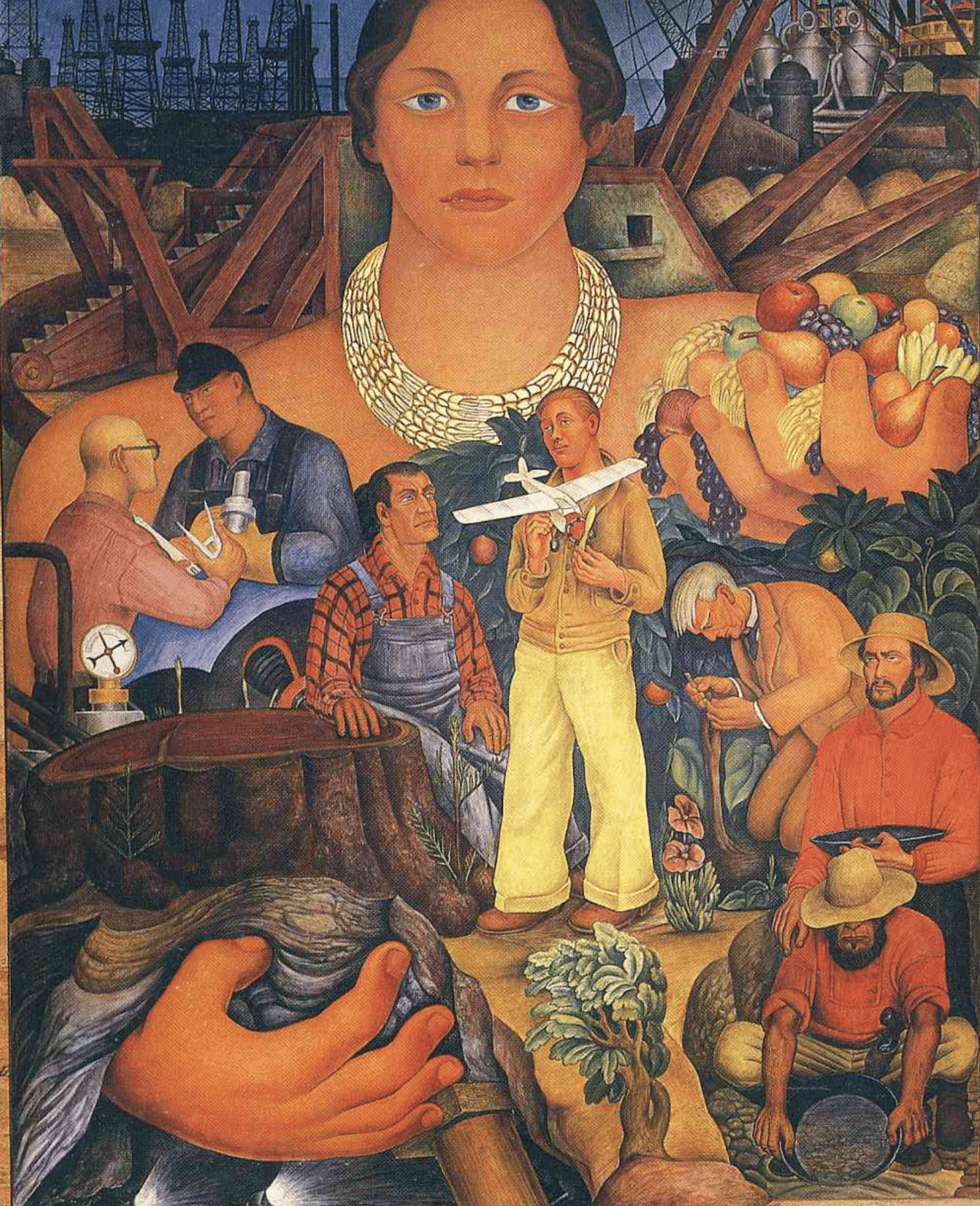
Allegory of California: Diego Rivera

Issue #00020: March 26, 2026

Hello readers,

I got back from Los Angeles this week with one thought stuck in my head: community. I spent the week visiting showrooms, meeting designers, and walking through the Pacific Design Center—all three buildings of it, green, red, and blue, like a massive Lego structure dropped into West Hollywood. You feel the scale the moment you enter. It’s continuous, like a grand piazza. You start doing square-footage calculations: four football fields across, by three widths. Maybe 200,000 square feet per floor? You can see how a space this size transforms the business of design, where proportion and light are the raw materials.

Then you see how empty it is.

Vacant hallways stretch for miles, drywall hangs loose, some of the escalators don’t work. An empty building inspires nothing. The D&D Building collapsed the same way. COVID hit and companies took road sales to designers instead of waiting for designers to come. The PDC emptied like there was a fire alarm. Management failed to spark new energy. Before long you’re walking through a deteriorating husk of a building where creativity used to live. Owned by a man, Charles Cohen, who never seemed to care—and cares even less now, distracted by his current financial woes.

I have a vision for how the PDC could thrive. Architects work alongside contractors. Fabric houses sit next to furniture makers, and younger designers learn from established ones over a shared resource library. The designer, the architect, the contractor, the stone fabricator, the upholsterer—all vetted, all aligned, all feeding referrals and ideas to each other, all under one roof. Designers and contractors alike struggle to find clients, but bring them together and the problem disappears. The PDC represents a lost opportunity to create that community, that design utopia.

You see, artists learn by gathering. The Impressionists famously painted together in cafés, argued about light, borrowed techniques, and pushed each other forward. Every jeweler in Manhattan’s diamond district sits next to his competitor, and the proximity keeps everyone sharp. The fish market in Venice works the same way. So did the D&D Building in its prime—five-year wait lists because the curation mattered. You learn interior design in practice, by touching materials, by watching how light enters a space. This work demands presence, and it demands a pack of fellow creatives around you 

I spent years trying to build this kind of community in New York City. Some of it worked. Some of it almost destroyed me financially. But that’s a story for another time.

So read on to find out why the wealthy are driving 50% of US spending, how war is threatening luxury’s recovery, and why everyone’s talking about Prada’s AI campaign.

See you next week.

Mr. Thread

Industry

Joseph Kleitsch: Laguna Road II

The coworking question
Speaking of designers and community, Business of Home’s Fred Nicolaus explores the history of coworking in our industry, and how it’s still thriving in some places. In Raleigh, North Carolina, a company called Workup is opening 8,700 square feet of shared space: a sampling library, warehouse, and conference rooms for the local design-build community. Owner Hilaire Pickett Martin built it because solo practitioners need community. Meanwhile, in Atlanta, designer Tish Mills moved from a standalone office to shared space and found that bumping into neighbors in the kitchen lifted her productivity.

“Designers share common workflows, challenges, timeline hiccups, success stories. The property includes a shared sampling library and warehouse and conference spaces, as well as flexible per-diem work desks, and aims to build community in a town that lacks design-centered gathering places.”

— Fred Nicolaus on Workup, in Business of Home

California rebuilds with character
Three stories landed recently that paint the same picture of California’s investment in beauty. New California Classics—a collective of more than 30 architects and interior designers—published a guidebook for rebuilding fire-ravaged homes in the Pacific Palisades and Altadena. There are seven distinct styles: California Ranch, Spanish Revival, Craftsman, California Modern, Storybook, Cali Cod, Colonial Revival. Each section lays out rooflines, window proportions, tile selections, and landscape plans with fire resilience baked in. National Today covered how Marvin Windows partnered with NCC to execute three of those styles with custom-engineered windows that honor the original proportions while upgrading performance. And Elle Decor profiled the broader mission behind the effort: one palette of home styles, one shared purpose. This is a genuine movement and it’s incredible to see.

While politicians argue over building codes and developers chase the cheapest option, the design community did what it does best—created something beautiful and handed it to the people who need it. (The New California Classics website is a design icon in itself). The homes that rise from these ashes will define a generation of Southern California architecture. This is community in action.

Next week: we sit down with Michele Trout from New California Classics to talk about how the project came together, what the team learned, and what it means for the future of rebuilding in California. Stay tuned.

Economy

Ben Norris: Discouraged Workers

War threatens housing and luxury comebacks
Analysts predicted 2026 would bring luxury back with 4–6% organic revenue growth across the sector. Then the war in the Middle East killed everyone’s buzz. Business of Fashion’s Eric Sylvers reports that luxury stocks fell sharply as the conflict escalated—LVMH, Kering, and Richemont all dropped. The Middle East makes up less than 10% of global luxury spending, but organic revenue there rose about 7% last year, outpacing every other region while the rest of the market stayed flat, according to Bernstein and Altagamma.

“Whether the conflict ends quickly or drags on for months, executives and analysts say the impact on luxury will not be defined by a sudden collapse in local sales. Instead, the greater risk lies in second-order effects: disrupted tourism flows, renewed oil price volatility feeding inflation fears, stock market swings that dent appetite for big-ticket purchases and a broader deterioration in consumer sentiment at a moment when confidence remains fragile.”

— Eric Sylvers, Business of Fashion 

“There is a symbolic value that is stronger than the war per se because it gives the sensation that you’re not safe anywhere. After September 11, the big impact was not the event per se, but rather the fear, the spreading fear regarding traveling and enjoying life and planning your holidays and the trust in the future.”

— Claudia D’Arpizio, senior partner at Bain & Company, Business of Fashion

HSBC’s Erwan Rambourg says recovery arrives regardless: “What hurt the sector for the past three years was not so much macro as self-inflicted pain and what potentially saves the sector this year and beyond is possibly not the macro but addressing those self-inflicted issues.” In other words, the luxury sector broke itself, and it can heal itself. 

At my company, the wealthy are still buying and business is good. But war chills everything, especially the housing market: Barron’s reports on how the conflict is hitting the US housing market through rising oil prices, Treasury yields, and inflation fears.

Sell to the rich
The Wall Street Journal reports that households earning more than $250,000—the top 10% of all earners—now drive 49.7% of consumer spending in America. That’s a record in data going back to 1989, when the same cohort was responsible for just 36%. The top earners increased their spending by 12% between September 2023 and September 2024, while working-class households cut back. (This is the K-shaped economy I was talking about last week.) The US now has 24 million millionaire households—more than China, France, the UK, Germany, Canada, Japan, and Australia combined. And America mints more than 1,000 new millionaires every day. Ka-ching.

“This group is driving the economic train with their spending. If they pull back, they’ll take the economy with them . . . Much of the resilience among high-income consumers is being supported—indirectly but powerfully—by the explosive run-up in AI-related stocks.”

— Mark Zandi, chief economist at Moody's Analytics, via The Wall Street Journal

I keep saying it, but the opportunity sits at the top. Money pools among the wealthy and keeps rising. At my company, the war hasn’t slowed us down—we’re taking million-dollar renovation commissions. Middle-market designers fight for scraps, but luxury clients keep spending. Target them. They’re the ones buying.

MillerKnoll grows 5.8% while the stock tanks
MillerKnoll—parent company of Herman Miller, Knoll, Design Within Reach, HAY, and Muuto—hit $927 million in Q3 sales, flexing 3.8% organic growth. Retail comps climbed 5.5%. CEO Andrea Owen says the company offset tariff costs and plans to double its store count over the next few years with new locations opened in Fort Worth, Pittsburgh, and Phoenix.

But the Middle East will definitely ding its Q4. Stock is dropping, but the balance sheet looks healthy: debt is down $41 million, leverage at 2.75x. Regular readers know I track groups like MillerKnoll as a bellwether for our industry. When they grow, it means commercial projects are moving and retail appetite for quality design is holding up. The retail expansion tells me they see something in brick-and-mortar that the DTC crowd missed: people need to sit in a chair before they drop $5,000 on it.

Mortgage rates highest since October
CNBC reports that the 30-year fixed mortgage rate hit 6.43% last week—the highest since October 2025. In response, mortgage applications dropped 10.5% and purchase applications fell 5%. Two weeks ago, rates slipped below 6% for the first time since 2022, then came the war and oil jumped to $119.48 a barrel on March 9. The 10-year Treasury yield climbed from 3.96% to 4.21% in two weeks. It’s like we can’t catch a break.

“Higher mortgage rates, coupled with affordability constraints and economic uncertainty, pushed some potential homebuyers to the sidelines. The threat of higher-for-longer oil prices continued to keep Treasury yields elevated, and mortgage rates finished last week higher. If the Iran war drags on, the most likely outcome for the spring selling season is a replay of last year, when market turmoil contributed to existing-home sales stuck at an anemic pace of just over four million.”

— CNBC

We’ve been predicting 5.5% as the rate that cracks the housing market open. But we’re heading the wrong way. Rate spikes kill renovation budgets. Homeowners locked into pandemic-era rates below 3% sit tight and wait for better math. Nothing moves until that logjam breaks.

AI antithetical to luxury
Prada released its Spring/Summer 2026 campaign—a collaboration with artist Jordan Wolfson featuring eerie, bird-like humanoid creatures alongside Nicholas Hoult, Hunter Schafer, and Liu Wen. The images are disturbing and they divided the internet. Business of Fashion’s Marc Bain reports that Prada confirmed AI was one of the technologies used, and the backlash came fast. Photographer Jack Davison commented on Prada’s post: “Oh great! More AI that no one is asking for.” CNN fashion critic Rachel Tashjian praised the strangeness but posted: “I hate AI.” 

“The underlying feeling seems to be that AI imagery is antithetical to the idea of luxury, which is supposed to celebrate human craft and creativity, to take its time and to spare little expense to offer the best possible product. AI, by contrast, is viewed as a way to be fast, cut costs and replace human creatives, whose work AI models were trained on without consent or compensation. At a moment when luxury’s value proposition is being scrutinised following years of rising prices, AI campaigns threaten to undermine the work brands are doing to win over customers.”

— Marc Bain, Business of Fashion

The smartest companies use AI for back-office work and keep it away from every client-facing touchpoint. At my brands, we are starting to shoot all brand photography analog—cinematic, old-school, through the artist’s eye. Consumers sense it when content is fast and cheap. That perception destroys luxury brands built on heritage and craft. AI is a brilliant operations tool but it’s a terrible creative director. Prada just found that out the hard way.

Emil Kosa Jr.: Near Modesto

Designing for longevity
Architectural Digest published a series on the longevity home—how your bedroom, your lighting, your spatial flow add years to your life. The science confirms what designers have known for decades: space changes how you feel and how long you live. AD also examines whether a home can help you live forever and makes the case that a longer life starts in the bedroom, including dimmable warm-toned lighting, transition zones, and flexible furniture that reduces sensory overload.

“When lighting is properly balanced, materials feel tactile, and space flows naturally, the body relaxes, and mental resilience improves.”

— Francesca Muzio of FM Architettura, Architectural Digest

The word is neuroaesthetics. Calming colors, relaxing curves, and materials that welcome touch. At my company, we’re opening a new showroom in Venice next month built on neuroarchitecture—we’re wiring guests with probes to measure heart rate and emotional response the moment they enter the space. Imagine an interior designer boasting on their website that their work extends your life. It sounds like marketing but it’s actually science. There’s an untapped market for designers who master wellness spaces: hospitals, therapy centers, and luxury residences for aging clients.

Loose Threads

  • Banksy has been unmasked, making some fans mad.  

  • Watch how the iconic Eames chair is made, and meet the man who breaks chairs for a living.

Playtime

Last week’s secret word was extra tricky. Entries flooded in, right and wrong alike. The answer? OPPORTUNITY. Our jurors are deliberating as we speak, and we’ll crown a winner next week.

Now, let’s see if you can guess this week’s common thread. It’s playtime!

  1. Analyze the puzzle below and guess the one word that connects all four images.

  2. Submit your answer HERE, or simply email us at [email protected].

  3. Type your answer in the subject field and hit send!

The Stakes: Every correct guess earns you an extra raffle entry, so play every week to boost your odds! We’ll draw the winner on April 22nd and announce them in the April 23rd issue. Our lucky winner gets:

  • A 1-hour private Zoom call with Mr. Thread to untangle your toughest business challenges.

  • A mystery gift from yours truly, Mr. Needle!

Good luck, Threaders!

Stay sharp,
Mr. Needle

Enjoying Mr. Thread?
How can we make this better? Reply to this email and tell us. We read every message and genuinely want to know what you think.

Reply

Avatar

or to participate