
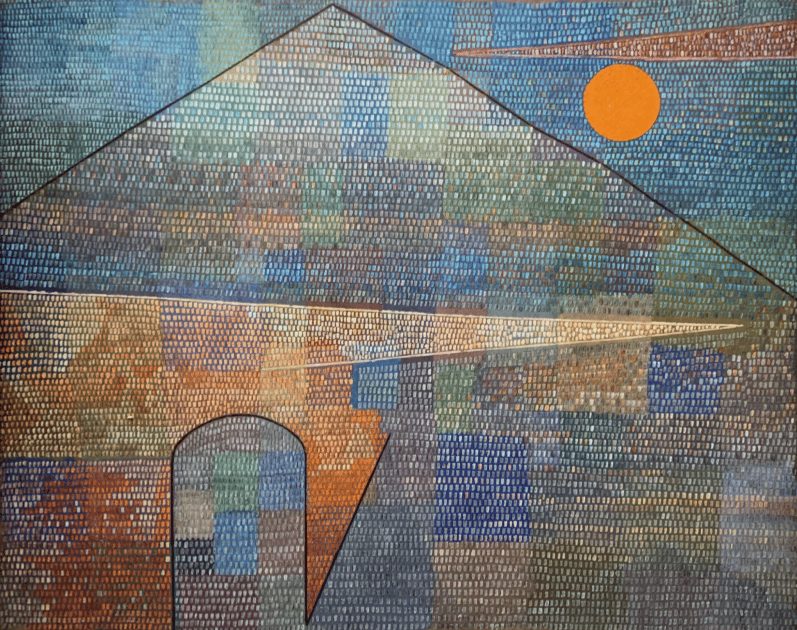
Paul Klee: Ad Parnassum

Issue #00021: April 2, 2026

Hello readers,

I’m going to level with you. This has been one of those weeks where I’m awake each morning at 3 a.m., staring at the ceiling, second-guessing every decision, wondering if the whole house of cards is going to collapse. I’m a 50-year-old entrepreneur with 30 years of experience, and I was rattled. For no good reason, sometimes it just happens. The boss had a bad week. I’m telling you this because I want my team, my readers, and my industry to know: I’m human. I learned that being fearless is an absolutely terrifying business.

This week it is Los Angeles that has my stomach in knots. The city I love more than anywhere on earth, and a city I cannot even come close to figuring out. It is so crucial to my business and so many of us in the American design industry, and it feels like what’s happening there is the canary in the coal mine for the rest of the country. 

The Wall Street Journal just published devastating data on Hollywood’s job market collapse—a 30% drop in production employment from its 2022 peak. Everywhere I look in West Hollywood, storefronts are boarded up. The new tax policy is driving our target customers away in droves. Then I read this story in Vulture about the creative exodus from the city, and wondered if investing in LA is a major mistake:

“The vibes in L.A. got very ‘We’re all so sad, we’re all so broke.’ It just made me feel hopeless. Not one person gasped or asked ‘Why?!’ when I told them I was moving. Everyone was like, ‘Good for you.’ Or even whispered conspiratorially, ‘I wish I could do that.”

— Lauren Bans, Vulture

But then I think of people like Michele Trout—who lost her home in the Palisades fires and turned around and organized 35 designers to create a guidebook for rebuilding with soul. I see the amount of business that’s going to flow to our industry from the rebuild, more fabric than I’ve ever sold in my life, potentially. I remember that LA still has the largest port in the world, aerospace, venture capital, tech, and weather that makes the East Coast feel like Siberia. Even if showbusiness scatters (and it’s looking increasingly likely) this is different from Detroit. Detroit only had one industry; LA has ten. Along with the most glorious weather and coastline to add to its spoils. 

So all week I’ve been flipping: bearish, bullish, bearish, bullish. And here’s where I landed. We’re pushing our chips to the middle of the table. We’re ALL IN on LA. The city that gave us the Eames house, and an obsession with light and space that’s not done yet. Sure, the city will need new leadership. Something institutional has to change. But LA is a city of comebacks—that’s the most American thing about it.

I write this newsletter to help everyone stay informed and find new opportunities. But I also write because I yearn for community. I want more than anything a place to share my struggles, my fears, my greatest losses. Thank you for hearing me out. I hope one day this grows to be a place for all of us to help each other through the hard times, as well as the good times.  

Enough with the sappiness…read on to find out how to get your tariff cash back from Donald Trump, why the Japanese are building American homes, and which country makes the best Easter chocolate.

See you next week.

Mr. Thread

P.S. Don’t just read—play. We’ve woven a new mystery into our PLAYTIME segment. Just one correct guess last week: Congrats Parker W. Scroll to the bottom to join the fun.

Q&A

Michele Trout on rebuilding California with soul
Michele Trout lost her home in the Palisades fires. Instead of retreating, she rallied. A 15-year member of the Design Leadership Network, Trout helped assemble New California Classics—a collective of more than 35 architects and designers who spent one weekend building a guidebook to save the architectural character of two devastated neighborhoods. 

How did you put it all together?
I'm from the Palisades, and my house burned down in the fires, and I realized that we had an opportunity to really come together as a community and do something. One of the things that was brought up was that we need to preserve the architectural integrity of the Palisades in Altadena, because there was quite a history, and we didn't want to see that all just disappear.

We identified seven different architectural styles that we wanted to see repeated in those areas. It was really an effort led by Jamie Rummerfeld, who also started Save Iconic Architecture. We just put out an all-hands-on-deck bulletin and said, who wants to help with this? And we spent a weekend together putting this all together. People flew in from all over the country. There were 35 people that came together that weekend. We divided ourselves into seven different teams, and each team was given a style. You didn't get to pick your style.

Are you providing actual architectural plans or just designs?
Just designs. This is really just a guidebook to be inspired by and to follow to give to your architect. Or you can give it to someone who is a draftsman—that's another avenue, it's much less expensive, and then hire an expediter to take it to the city. It just requires more legwork. But it's really for purists who want to build a beautiful home.

I think one of the biggest problems that these neighborhoods are facing is that these are not people who would ever design a custom home. Now you have over 8,000 people designing a custom home who never would have done that before. That's a whole other ball of wax. It requires so much thought, it requires tremendous resources, it requires time. It's not something you can do quickly, and I think people are just wanting to get things up and go, and that's a problem as well.

Of the seven designs in the book, which is your favorite?
That’s a great question. I thought to myself, Storybook—what is that? Is that the witch's house [in Beverly Hills]? And it turns out that the first rental house that we lived in after the fire was, in fact, a storybook house from 1927, and it's such a charming style, and I ended up really loving it. Storybook is a very charming style, and you can build a small storybook house that makes a lot of impact. 

Is there a risk that people will rebuild in that horrible concrete box style you see all over Beverly Hills?
Yes, they're doing that. Price is a big problem right now because people were very underinsured, and so they are just trying to figure out how they can get this done and not spend all their money doing it, because it's very expensive to build right now. I do think that people are going to go to people who do prefab homes, people that do these kind of Thomas James homes.

I don't think that a lot of the houses are going to look very good. I'm really, actually quite upset about it, because people are trying to do it fast and inexpensively and that's never good. And these houses aren't going to last. They're not going to be the 100-year houses. They're just not going to last because people are trying to do it too inexpensively.

“I don’t think that a lot of the houses are going to look very good. I’m really, actually quite upset about it, because people are trying to do it fast and inexpensively and that’s never good. And these houses aren’t going to last. They’re not going to be the 100-year houses. They’re just not going to last because people are trying to do it too inexpensively.”

— Michele Trout, Design Leadership Network

Why were so many people underinsured?
This is where it gets ugly. So State Farm, in November—the fires were in January—they canceled many, many people's insurance. Once State Farm canceled your insurance, your only option was to go to California FAIR Plan. And California FAIR Plan, the maximum amount of money that they will give you is $3 million, and that $3 million covers your house, your contents, and your living expenses until you rebuild the house. An average lot in the Palisades before the fire was probably $4 million, so you're not even getting lot value. There's a lot of lawsuits going on right now. People think that they were unjustly targeted because they had expensive homes.

What will the Palisades look like in five years?
I think it'll be 75% rebuilt, and I think that it's going to look like a complete mishmash. I'm already looking in my neighborhood, and it's a total mishmash. There's no direction, there's no architecture review board anymore. There's no HOA, there is nobody supervising this. So you can build any kind of house you want.

In the alphabet streets, you can max out your lot. You cannot believe how big these houses are going to be in the alphabet streets. And the alphabet streets are the smallest lots in the Palisades. The streets are very narrow, and they're maxing out the lots and building these huge houses. It's going to look like Manhattan Beach. It's going to be terrible.

What would you say to someone considering building a cheaper, prefab home?
I would tell them to really take their time, that they have time. They're making a big investment in money and time. And also, I would ask, what is it that you want to put out into the world? Do you want to put out something really special and beautiful, or do you want to put out something like everybody else is doing? There's going to be many, many of those kinds of homes in the Palisades. But I think if you have the means and the inclination, you should perhaps consider something more special.

Find out more at: New California Classics.

Industry

Paul Klee: Black Columns in a Landscape

Cohen’s empire keeps crumbling
One more bank has joined the list trying to collect from Chuck Cohen, and this one is focused on a rather unknown portion of the Decoration & Design Building, one that houses some of this industry’s treasures.

US Bank has filed to foreclose on 222 East 59th Street, according to The Real Deal. The lender says Cohen, who is up to his eyeballs in debt, defaulted in September and hasn’t paid his bills. The building is technically separate but considered part of the D&D Building—home to more than 100 showrooms.

This is the annex building on 59th Street that Cohen developed around 2001 and interconnected to the D&D through the fifth floor. Companies have long-term leases there. 

What happens if just that building gets partitioned off in foreclosure? Forbes estimates Cohen has lost about $2.1 billion in net worth between 2023 and 2025. Earlier this year he lost 750 Lexington Avenue in a foreclosure auction. Fortress Credit scored a $187 million personal judgment against him. 

I’ve spoken with several real estate broker colleagues who tell me Cohen is cooked, but they won’t go on the record saying so—because he still has influence in the city. 

Ol’ Chuck won’t stop me from trying to get more info… stay tuned.

Kelly hits the high street
Kelly Wearstler is launching a 29-piece furniture, lighting, and accessories collection with H&M Home—her first time showing at Milan design week, and H&M Home’s first-ever furniture collaboration. The collection drops in 40 countries from September. Dezeen reports it will be unveiled at Palazzo Acerbi, a 17th-century baroque palace in central Milan. Fancy.

We talked about the Birkin bag a couple of weeks ago and how luxury companies aren’t just doing badly because of the economy—they shot themselves in the foot with overexposure. 

Kelly is a treasure for our industry, and I hope she doesn’t stretch too far. She is just too damn good… I don’t expect her to mess this one up.

“I love that I can reach that higher collectible audience, but also now having this partnership with H&M and doing something that’s super accessible, I love that dichotomy. This is my Milan Design Week debut, and H&M Home is the perfect partner. Their global presence and genius for storytelling align perfectly with my vision. Bringing this collection to life in Milan and showing people how the pieces come alive in a real space. That’s what excites me.”

— Kelly Wearstler, Dezeen

1stDibs’ new podcast is a snoozer
1stDibs has launched “Objects of Desire,” a biweekly podcast where guests talk about a single art or design object that holds deep meaning for them. Furniture Today covered it—which tells you everything about how exciting it is. (I couldn’t even bring myself to listen.)

Mr. Thread has been begging 1stDibs to do something bold. They sit at the most unique position in our industry—an institution, a name, a marketplace with incredible reach. And they just came out with…a podcast about objects. It reads like someone asked ChatGPT to “make me a podcast for 1stDibs.” Nothing original, nothing authentic, nothing that makes you want to tune in. 

This company keeps squandering every business opportunity to become the backbone of our industry.

You must be wondering, what’s the opportunity here? Why am I going out of my way to bash a podcast from a furniture marketplace? 

Because I see a huge opportunity in the podcast space. Something fresh, edgy, original, and raw is what we are missing. Our industry keeps putting out safe and sanitized content. 

For the brave who zig, while others zag, a huge design media empire could be built.

It’s never too late to learn
Architectural Digest just published its list of the 17 best interior design schools worth applying to in 2026. It’s a solid roundup—Parsons, Pratt, RISD, Auburn, the usual suspects. AD100 Hall of Famer Jamie Drake puts it well: formal schooling is an absolute necessity at the high end.

But flip through every one of those 17 programs and you’ll notice something missing: the business of design. It’s all drafting and AutoCAD and STEM certification. 

Where’s the course on how to make a living? How to set fees? How to run a P/L? These schools are churning out brilliant creatives who can’t pay for the education they just received. Mr. Thread exists partly to plug that hole—business advice for an industry that’s starved for it. One of my dreams is to build an academy that teaches both art and commerce.

Perhaps Mr. Thread is the first step?

“To really work in the high end of the industry, formal schooling is an absolute necessity. It isn’t just about whether you can say, Oh, that floral looks good with that stripe. It’s about mastering foundational design principles and developing fluency with the rendering and software tools required of day-to-day work. It’s about designing to satisfy a question.”

— Jamie Drake, AD100 Hall of Fame, Architectural Digest

Economy

Paul Klee: Fish Magic

RH: the audacity of mediocrity
“Reclamation” Hardware just reported Q4 earnings and the stock cratered 19% in after-hours trading—down to $112 from $139. The Wall Street Journal reports that revenue came in at $842.6 million against expectations of $873.2 million, with $30 million lost to tariff-related resourcing and another $10 million to bad weather. The stock is now down 40% over the past year.

I sat through Gary Friedman’s annual presentation set against this boring-ass piano music, just so you don’t have to. The man starts off predictably agitated—defending the numbers, rattling off free cash flow up $466 million, EBITDA growth, yada-yada. The metrics he cherry-picks look fine. But Wall Street doesn’t buy it, and I don’t either. 

His whole thesis is flawed: he wants to “scale taste.” He compares the business to Louis Vuitton and Hermès. He calls RH “the arbiter of the home.” The audacity of this guy: Home is too personal for any brand to own.

The greatest designers in the world cringe if you can identify their signature. Studio Peregalli doesn’t want you to know it’s a Studio Peregalli room—the signature is the homeowner, the light, the color… the feeling. 

RH has the opposite problem: you know exactly what an RH yacht, an RH restaurant, an RH estate would look like before you see it. In the business of home, that’s a death sentence. 

RH is inauthentic and unoriginal, and educated consumers can smell it. Their European expansion on the Champs-Élysées—renting a gorgeous building and filling it with poorly-made furniture—shows a total lack of cultural understanding. What they call “interior design” is a shopping service for their own door-busting catalog with a factory of mid-level designers churning through projects. It’s a net negative for our industry.

But there’s so much to learn from this very intriguing company, so we will keep letting it live rent-free in our heads.

Tariff portal is coming
Business of Fashion reports that a US tariff refund portal is about to open, though it will exclude one-third of imports at launch. If you lost money in these tariffs and you’re hoping for a refund, be vigilant. Follow the links and keep checking back. 

I’ve already instructed my team: the moment that portal is live, I want us to apply by the end of day. If Uncle Sam sends me back a check for half a million dollars, all is forgiven. Industry readers, whoever is tracking this for you—light a fire under them. The COVID relief money went to the people who got online fastest and this may or may not be different. But I do know this… when it comes to government refunds, I know I’d rather be first in line.

UPS has a guide on what you can do now.

Japan bets big on American homes
Japanese builders have acquired 23 US single-family home builders since 2020—more than double the number from 2013 to 2019. The Wall Street Journal reports that by some estimates, Japanese builders are set to own about 6% of the US home-construction market. Sumitomo Forestry’s $4.5 billion acquisition of Tri Pointe Homes will make it the fifth-largest home builder in America. This is fascinating to me.

So, Japan’s birthrate has declined almost every year for a decade. Their domestic market is shrinking. Now they’re playing the long game, and the long game in American housing makes sense. Factory-built housing is far more common in Japan, and some of these companies are starting to bring prefabricated construction to the US—higher quality, faster builds, more efficient processes. But this business model only pencils out in a dire economy, which isn’t a great sign for the American housing market.

“If the economy was going gangbusters and all you had to do was stick a sign out in front of the house to sell it, no one would have any interest in Sekisui House technology.”

— Toru Ishii of Sekisui House, The Wall Street Journal

Foreign-led big money deals run on local expertise. Show up with taste, connections, and ground-level knowledge and you can win massive contracts.

Paul Klee: Temple Gardens

Mr. Thread’s top 5 from the DLN study
The Design Leadership Network just published its latest industry survey in The Quarterly, and the data tells a stark story about where business is heading.

We already love DLN, their founder and their mission. Now we love them even more. DLN published this survey freely. They should be charging for it. But Mr. Thread found it, and we’re sharing it with you. We don’t gatekeep the good stuff.

Here are the five stats that matter:

  1. 73% of small firms say business is flat or worse. Firms with fewer than five employees are getting buried. 36% said business decreased, another 29% said it stayed about the same, and 8% said it decreased significantly. That’s nearly three-quarters of small practices treading water or sinking.

  2. 85% of large firms expect revenue to grow. Firms with 100-plus employees are bullish—85% expect their revenue this year to be significantly better than last. Of the smallest firms, 63% say they expect the same or less. The gap between the top and bottom of our industry has never been wider.

  3. Lighting leads the way—again. 95% of interior designers specify lighting on their projects, making it the number one vendor category for the 20th year running. Every room needs light, obviously, but furniture—which every room also needs—comes in at 85%. If you’re in the lighting business, congratulations.

    (The Financial Times has further reading about the return of the chandelier, here.)

  4. 50% of designers want to buy more art. When asked which vendor categories they’d like to engage with more over the next 12 months, half said art and accessories. The desire is there. The question is whether they have the clients to match.

  5. The software landscape is stuck in 2015. 41% of designers surveyed use Studio Designer. 41% are on Microsoft Teams. Very few are using modern tools like Notion or Trello. 99% of software use is for project management alone. The industry is ripe for disruption.

The stitch that money can’t mass-produce.
The New York Times’ Jason Diamond profiles a small but growing movement of chain-stitch embroiderers who are building thriving businesses. Emily Simpson of Chain Smoke uses a 1966 Singer machine to sew lettering into vintage army jackets for clients like Josh Safdie and Stevie Wonder. Brian Blakely stitches custom varsity jackets out of Bushwick for Calvin Klein and ASAP Rocky—upward of $700 a pop, and people can’t get enough. 

In 1972, 9,400 embroidery workers operated within six miles of road in New Jersey, but the industry nearly died when the work went overseas. Now it's coming back, one stitch at a time, because consumers are rejecting fast fashion in favor of the handmade. 

This is what Mr. Thread has been saying all along: the human Renaissance is real. People crave what a machine can't fake, and as you know, I’m super bullish on handmade.

"Without sounding woo-woo about it, there’s a spiritual connection between physical human hands being in the process that makes it more special. I will absolutely accommodate if I have clients who really want to do something that requires a couple of stitchers. But clients choose to come to Chain Smoke for her work."

— Emily Simpson, Chain Smoke, The New York Times

Apple turns 50
Apple celebrated its 50th anniversary this week, and both Wallpaper* and The Verge published beautiful retrospectives with some truly great photos. When Steve Jobs came back to a company selling beige boxes and turned to Jony Ive to create that blue clamshell iMac—has there ever been a greater example of art and business joining together in one explosive moment? 

Apple is the greatest luxury company ever built, even if most people don’t call it luxury. Time, hedonism, the experience of opening the box—it checks every principle. 

But let’s not leave them unscathed. Since Jony Ive left, there has been zero innovation. The software is a disaster. Liquid Glass is illegible, basic browser tabs require six clicks, and the Vision Pro botched the one experience that could have saved it: live sports.

Unfortunately, at this point, Apple has become a public utility, like the gas companies. I think their ability to create once-in-a-generation iconic products is over.

The Salone opportunity
Milan’s Salone del Mobile is the most spectacular design show on earth, and Domus has just published a gorgeous guide to the hidden historic palazzi you can visit during Fuorisalone 2026. This is what makes the show so extraordinary: It’s like you’re strolling through 17th-century courtyards watching the most avant-garde, original thinkers put on incredible exhibitions in the middle of Milan.

I’m not going to be at Salone this year, and it kills me. I’m working on getting boots on the ground for a report. In the meantime, I encourage every reader who can make the trip: go with no agenda. Just keep your eyes open for opportunity, see trends, shake hands. 

The most valuable business connections I’ve ever made happened at trade shows where I had zero plan. And yes, Gary Friedman just announced he’s dropping an RH gallery right in the middle of Milan so he can ride the Salone wave too. Imagine. The most authentic design show in the world, and this guy parks a catalog store in the center of it. That’s why people don’t think he’s authentic. (Sorry, I had to fit in one last petty insult.)

Tech

Paul Klee: Red Balloon 

Pinterest for people with taste?
Business of Home’s Fred Nicolaus profiles Cosmos, a visual curation platform that just raised $21 million and is quietly becoming the mood board of choice for serious designers. Teams at Nike, Apple, and Chanel are on it. It’s being sold as a clean, beautiful alternative to the algorithmic slop bucket that Pinterest, Instagram, and TikTok have become. Cosmos uses machine learning to rate every image on the platform and de-ranks anything below a certain quality threshold—that’s robots fighting robots, if you’re keeping score. The killer feature for our industry is “research captions,” which automatically tags images with provenance: click on a green art deco staircase and you'll learn it's from Cranbrook Academy of Art, designed by Eliel Saarinen in 1925. 

"I think one of the biggest problems in visual culture is the lack of provenance, and the idea that as an artist or a creative, you upload your image onto the internet and you're under this weird invisible contract that your thing is going to be ripped off and reposted, and you're going to kind of lose control over that thing. We're trying to serve the creatives and make them the pillars of the platform."

— Andy McCune, founder of Cosmos, Business of Home

The reality is, Pinterest could quickly spin up a quality filter and a provenance tool tomorrow and wipe this out overnight. That would leave Cosmos looking like a high-end stock image library with AI search bolted on. I’ve seen this play before: a beautifully curated startup that solves a problem a bigger platform can copy in one sprint cycle. Show me the moat. Until then, this is a big yawn for me.

Tinder for sofas (Happy April Fools’ Day)
Furniture Today reported, with a straight face, about Intiario’s new app that lets you swipe right to select your dream sofa—a “first-ever Tinder for sofas” that collects style preferences through a swiping interface. I downloaded it, swiped for a few minutes, and learned the whole thing is a prank. Furniture Today fell for it, but in their defense, they did catch this one about an anti-gravity blanket.

(In other April Fools news, Ken Fulk nearly caught us out with this one.)

Loose Threads

  • 432 Park Avenue is the enshittification of the week: a concrete middle finger from Billionaires’ Row to every New Yorker with taste.

  • Another casualty of the war: Christo and Jeanne-Claude’s Mastaba in Abu Dhabi (what would have been the largest sculpture on earth) is now at risk of never being built.

  • Venice gets the Carlo Scarpa it deserves: a new exhibition of three houses by the master of Venetian detail. Can’t wait to visit this next month. 

  • A judge halted the White House ballroom project, and meanwhile a Trump video skyscraper presidential library has been proposed, because subtlety was never his brand.

  • Stunning Easter chocolates from around the world, because I can’t help myself. I’m going to eat my body weight in chocolate this Easter, and so should you.

Playtime

Congratulations to Parker W! He correctly guessed last week’s magic word: COMMUNITY.

Now, let’s see if you can guess this week’s common thread. It’s playtime!

  1. Analyze the puzzle below and guess the one word that connects all four images.

  2. Submit your answer HERE, or simply email us at [email protected].

  3. Type your answer in the subject field and hit send!

The Stakes: Every correct guess earns you an extra raffle entry, so play every week to boost your odds! We’ll draw the winner on April 22nd and announce them in the April 23rd issue. Our lucky winner gets:

  • A 1-hour private Zoom call with Mr. Thread to untangle your toughest business challenges.

  • A mystery gift from yours truly, Mr. Needle!

Good luck, Threaders!

Stay sharp,
Mr. Needle

Enjoying Mr. Thread?
How can we make this better? Reply to this email and tell us. We read every message and genuinely want to know what you think.

Reply

Avatar

or to participate