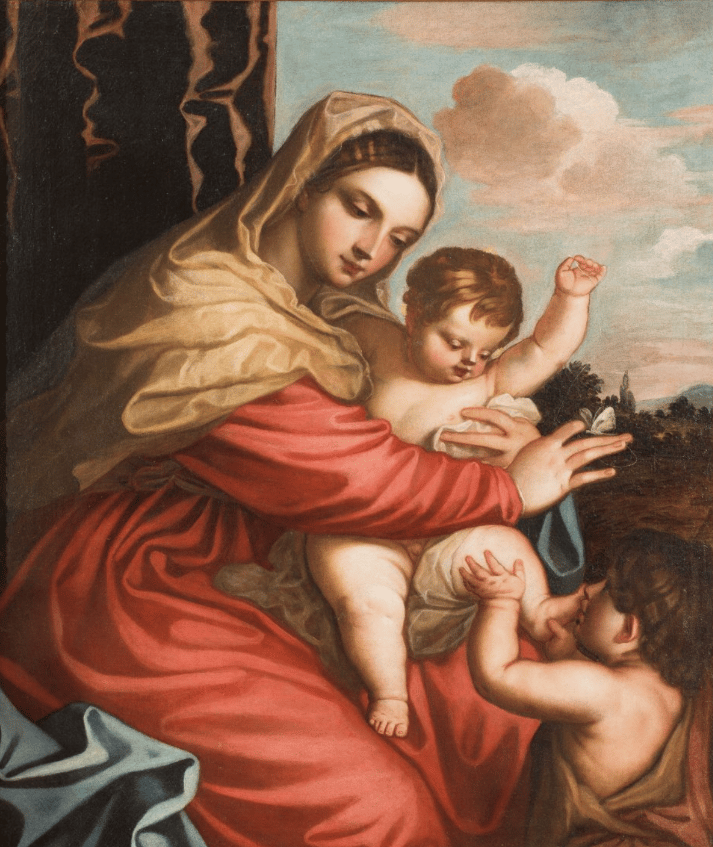
Alessandro Varotari: Madonna con bambino
Enjoying Mr. Thread?
Hit reply and tell us what you think. We read every one—and we write back.
Issue #00026: May 7th, 2026
Hello readers,
I’m writing to you from Venice, Italy, where the Art Biennale has just kicked off—and the city is absolutely buzzing. Every two years, the entire art world descends on this place for one extraordinary week. Gallery owners, politicians, celebrities, creative directors, collectors—all crammed into the most beautiful city in the world. The people-watching alone is worth the airfare, which is also insane. Imagine the Met Gala dropped right into the middle of the Venetian lagoon, except everything is happenstance. Reunions on bridges, chance encounters on vaporetti, beauty everywhere you look. And then there’s me—the biggest doofus in the room, wearing Gap denim and J.Crew khakis while everyone else has diamond brooches, embroidered velvet shoes, and hats by designers I couldn’t name if my life depended on it.
This week also marks the opening of the Fondazione Dries Van Noten at the 15th-century Palazzo Pisani Moretta—over 200 pieces, from Comme des Garçons to Christian Lacroix couture, all under the banner The Only True Protest Is Beauty. (There were real protests here, too, if you watch the news.) I was lucky enough to get a private tour from the Palazzo’s architect, Alberto Torsello. Imagine the difficulty of renovating a 15th-century palace, with no electricity or indoor plumbing on some floors.
I love being in Italy. No one really talks about America here, which is a breath of fresh air for this North Carolina resident. Sure, I’m keeping up with the news back home: President Trump told a crowd this week that “we’re going to bring all the furniture back to North Carolina.” Meanwhile, The New York Times just published a piece on Hickory, North Carolina, showing the real recovery has come through healthcare, data centers, and fiber optics—not manufacturing. There, Century Furniture’s CEO says his tariff bill is 10 times what it was before. The politics are loud, but the reality is quieter and more complicated. I need another Americano.
Our industry is alive and well with the best yet to come! See you next week.
Mr. Thread
P.S. Don’t just read—play. It’s the first week of our brand new quiz. Scroll to the bottom to join the fun and secure a spot for our grand prize draw.
Industry

Giovanni Battista Piazzetta: Madonna and Child with an Adoring Figure
A new home for Business of Home
Big media moves in the home world. Ziff Davis—the digital company behind CNET, Mashable, and TheSkimm—has acquired Dwell, Domino, and Business of Home from Recurrent Ventures. The three titles land under a new lifestyle group at Ziff Davis, with BOH founder Julia Noran Johnston running the show.
A hearty congratulations from all of us at Mr. Thread. I have been reader number one since day one. I also happened to be one of the first guests on Dennis Scully’s wildly popular podcast. Julia and her team built something all of us in the industry desperately needed: actual journalism with a voice and a community behind it. Class acts all around.
(And between us, a few readers have mentioned that since Mr. Thread started publishing, they detect a certain Mr. Thread-style attitude creeping into BOH features. We’re flattered.)
The last tassel maker
Jessica Light might be the last person in London’s East End still weaving passementerie by hand. Every tassel, tieback, and rosette is hand-woven to order using techniques dating to the 16th century. She’s worked for Vivienne Westwood and Buckingham Palace. At this year’s London Craft Week (May 11–17), she’ll unveil two new bodies of work and open her workshop for a one-off tassel-making class. In a city where traditional trades are vanishing, Light continues to prove that old textile skills can feel radical and unmistakably modern. This is the kind of craft story our industry needs more of.
“For the exhibition [Jessica Light] is unveiling two new bodies of work. The first, The Phoenix and the Carpet, is a series of home and body wares inspired by imagined cities and urban landscapes, with shades that recall brass, wet tarmac and weathered steel.”
Ashley’s luxury problem
Ashley Furniture—the country’s largest furniture retailer with 1,100+ stores globally—just launched Ashley Luxe across 70% of its locations. Sofas start at $1,000–$1,200, sectionals run $2,900–$6,000, and the new face of their campaign is actress Hailee Steinfeld. Business of Home reports this is their biggest bet yet on moving upmarket (if you consider $1,000 sofas luxe, which, clearly they do).
The whole thing just seems off. How do you put “luxe” and “Ashley” in the same sentence? The K-shape recovery we’ve been tracking answers that question—the top of the market is spending while the middle gets squeezed, and Ashley sees daylight. This is a diversification play, I think. They won’t abandon the lower market—that’s the golden goose—but straddling both ends during a downturn is a dangerous game. We’ve seen that movie before.
“The timing of this introduction is very intentional. We believe the consumer today is more discerning. She wants better value without compromising style and quality. She wants luxury at a price.”
Trends

Tintoretto: Mother and Child
Uncle Sam’s search for beauty
The Trump administration has created a National Design Studio, appointed Airbnb co-founder Joe Gebbia as Chief Design Officer, and just named branding executive Peter Arnell as Chief Brand Architect. Say what you want about POTUS (and I gave him a hard time in last week’s issue), but he’s fully MABA (Make America Beautiful Again.)
Don’s two executive orders—Improving Our Nation Through Better Design and Making Federal Architecture Beautiful Again—mandate classical or traditional styles for new federal buildings. The GSA is now hiring a senior architectural advisor with “classical” appearing eight times in the job listing.
I love the idea—this may be the first president in our lifetime who’s actually prioritizing building design. But execution is everything. If you go to the New York Public Library, it’s glorious. If you go to the DMV on Long Island, it’s a war crime. If you’re serious, Don, start there.
“This government, unlike many, wants to move at lightning speed. We’re living in an environment that’s a different type of government and one that demands ‘yesterday’ as a deliverable date.”
Desperation marketing
I’m shaking my head in disbelief. Beauty brands are staging fake scandals to game the algorithm and attract more eyeballs. ColourPop posted a phony apology. Lancôme sent intentionally misdirected PR packages. Dieux announced a fake AI pivot. Business of Fashion calls it “2026 guerilla marketing.”
You see, follower counts are dead, and brands now chase shares and saves—the primary engagement signals the algorithms reward. But this new tactic is bait-and-switch dressed up as strategy. This will expire fast, believe me. The second consumers realize the drama is manufactured, trust evaporates—and you can’t get it back. The whole thing feels creepy—a race to the bottom.
“It’s basically 2026 guerilla marketing. The Internet thrives off drama and shock, and here’s a new way to do that.”
Death to LEDs
I’m writing this from Venice, where the streetlights glow rose. I’m not being poetic, it’s the city’s policy. When gas lighting hit the city in the 19th century, Venetians hated it. Artists complained about the harshness. The fix was rose-tinted glass lanterns that filtered glare into something closer to candlelight.
Light here is never seen directly—it bounces off brick, Istrian stone, canal water, mist, old plaster. A hard white bulb would be considered an act of violence here. Meanwhile, back in New York, Curbed reports that apartments from Crown Heights to the West Village are turning amber. Residents are ripping out cold LEDs for warm smart bulbs from Philips Hue, Govee, even $6 Ikea options.
LEDs make you sad, make you look terrible, and the science says they’re bad for you—blue light kills melatonin, and a Norwegian hospital found orange lighting reduced patient aggression. Maybe this is why my blood pressure drops every time I fly from JFK to Venice.
Once again, we see massive opportunity in this welcomed trend. As people start realizing how bad it is for you, they will begin searching for products and designers to help them “healthify” their spaces.
“Venice’s streetlights are rose-colored because the city learned that light, like fabric or glass, has to be tuned to its surroundings.”
High Point trends
Last week, Chad Smith gave us the insider’s view of High Point—the reps in bad suits, the showrooms running on the same tired script, and the 313 Space shaking things up. Now AD PRO has published its trend report from Spring 2026 Market. (It’s worth noting that Mr. Thread delivered our High Point report five days earlier than the best of the shelter mags!) Anyway, the signals confirm what Chad was feeling on the floor: the industry is finished with sterile minimalism.
Here are AD’s highlights: Vanguard’s showroom was dripping with passementerie—triple-decker fringe in silver, marigold, and terracotta, “enough to outfit a dozen Gilded Age mansions.”
Nikki Levy debuted a Draped Desk at Abner Henry with undulating wood supports that mimic a wall of curtains. Outdoor furniture from Harbor, Century, and Four Hands is now fully upholstered and indistinguishable from your living room. Coastal blues are the counterpoint to last year’s boring aubergines. Menswear fabrics—tartans, tattersalls, suiting plaids—are dressing up everything from slipper chairs to beds. And the quest for bigger continues: James Martin is pushing vanities to 120 inches, Arteriors is supersizing chandeliers, and Janus et Cie’s extendable dining table stretches to 106 inches.
Everything is getting larger, louder, and more layered.
“In a world that has felt increasingly digital and sterile, people are craving rooms that feel warmly human again where they can be more expressive.”
Ernesta gets aggressive
Ernesta—the direct-to-consumer rug brand founded by Peloton’s John Foley—just opened its eighth store, in Manhasset, New York, with seven to eight more planned by year’s end. Foley estimates the business will hit $100 million this year.
Home Accents Today reports that everything is custom-ordered from rugs sourced globally and fabricated in Cartersville, Georgia. This is all well and good, but just look at that showroom photo—swatches on rails, sterile lighting, zero soul. This is commerce dictating design, and the last time that happened, the entire world turned beige.
A tech guy started a rug company, and it looks like a tech guy started a rug company.
Opportunities

Lorenzo Lotto: Madonna and Child with Saints
Put the YOU in ADU
Homes built for multigenerational living—think in-law suites, accessory dwelling units, extra kitchens—are commanding a 65% premium over standard listings, with a median asking price of $709,000. Fast Company reports that demand is strongest in California, where Los Angeles (23.7%), San Diego (22.7%), and San Jose (18%) lead the pack. The economics make a lot of sense: per-square-foot pricing hits $262 versus $215 for traditional homes. For designers, this is a growth category worth chasing.
There is a big opportunity here. These buyers need thoughtful space planning—and they’re willing to pay for it. Especially with the boomer generation in their twilight years, I expect this boom to continue for a while.
“Multigenerational living is a meaningful force in the housing market. A sense of shared purpose and care is at the heart of multigenerational living, a housing arrangement that is quietly shaping American family life.”
Economy

Giovanni Bellini: Madonna and Child
Louisville is off to the races
Louisville, Kentucky, sold 287 homes above $1 million last year—up from just 43 in 2010. What’s happening there? The Wall Street Journal reports that young buyers from Charlotte and Nashville are driving the boom, drawn by what locals call “lifestyle arbitrage”—the cultural energy of neighborhoods like NuLu and Butchertown at a fraction of coastal prices.
Developer Gill Holland likens NuLu to New York’s East Village circa 2005: “creative energy and cheap rent.” Top-tier Kentucky Derby tickets now run $18,000 for two days (did anyone happen to catch that insane comeback at the race last week?) Some visitors spend over a million on a single Derby trip. Hunter S. Thompson would be spinning in his grave. The money is real, and it’s reshaping the city.
For designers and brands, Louisville is a market to watch.
“We’re at this point where we’re trying to figure out how we invite others in, while still keeping what’s important to us.”
Loose Threads
A $400 million LA home just became the most expensive listing in American history. Ka-ching!
Business Insider ranked the coolest building in every state—most of them should be on every designer’s pilgrimage list.
This Instagram post shows how designers can use Claude Design, and it is sick.
Frank Gehry’s Sirmai-Peterson residence in LA just sold. A piece of architectural history changes hands.
Diane Keaton’s legendary eye for interiors goes under the hammer—Bonhams is auctioning her collection. (See the house tour here.)
In Venice? Don’t miss designer Chahan Minassian’s third curation of the historic Fortuny Palazzina.
Playtime
This is it, Threaders—the official launch of our brand-new game! We’ve retired the old format to bring you a game of wit and deduction. Every correct answer you submit each week earns you points toward our next big giveaway. Let’s see if you can crack this week’s code. It’s playtime—good luck!

The Clue: The mastermind behind our weekly issues.
Piece together the mystery word based on the clue provided above.
Click HERE to submit your answer.
Type your answer in the subject field and hit send!
The Stakes
Every correct guess earns you points that accumulate for our upcoming raffle. The more you play, the higher your chances of winning. We’ll be holding the grand draw on July 29! Our lucky winner gets:
A featured spotlight for you/your firm in an upcoming issue of Mr. Thread.
Another special mystery gift from yours truly, Mr. Needle.
Stay sharp,
Mr. Needle