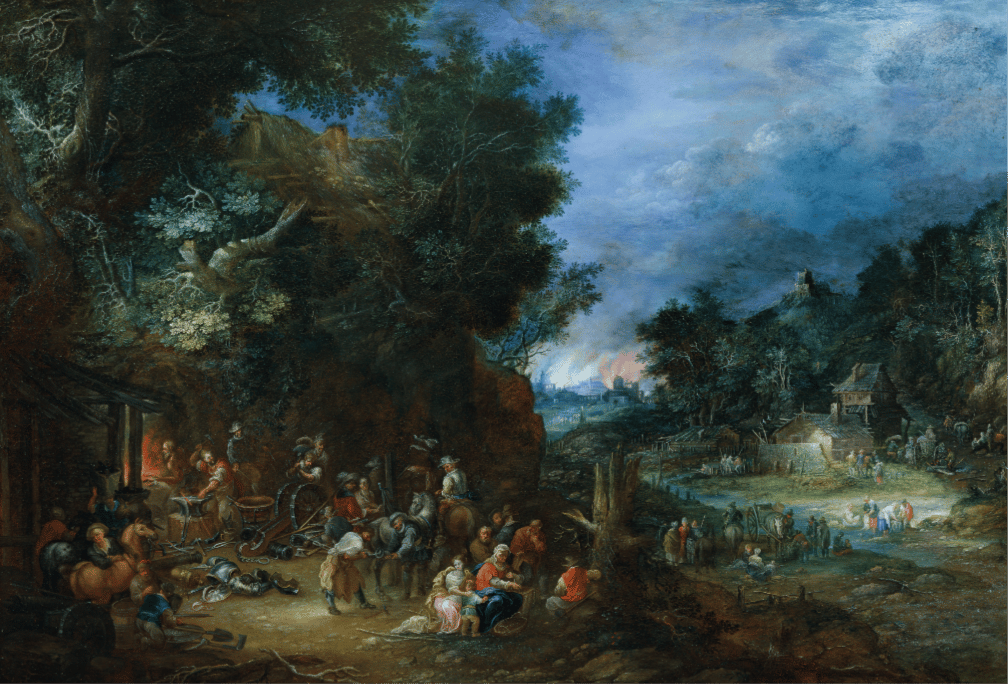
Johann Jakob Hartmann: The Four Elements: Fire
Enjoying Mr. Thread?
Hit reply and tell us what you think. We read every one—and we write back.
Issue #00027: May 14th, 2026
Hello readers,
I’m back at my desk in North Carolina after a week in Venice, swapping espresso for bourbon. I blame jet lag. The post-travel fog is real. But so is a stat I stumbled on this week that cut right through the haze: in 2023, half of Gen Z said their dream career was to be an influencer. They just ran the survey again. The number is now 5%. Thank God, it seems nature is healing.
I’m considering killing Instagram advertising for one of my companies. The platform has just become an endless scroll of ads, AI-generated slop, and algorithmically juiced product placements. It seems Zuckerberg’s Meta is becoming the modern-day equivalent of Philip Morris. Terrible for you and your business, but everyone’s doing it and we can’t quit. But the tide is turning…
Deep, authentic newsletters, YouTube, non-algorithmically driven content (i.e., art)—that’s where people are going to learn and engage. And a fascinating essay by an economist at Stanford (thanks for the tip, Jacob!) makes the case for why that shift matters: in a world flooded with slop, the scarce thing—the valuable thing—will be the human touch: the handmade, the provenance, the person behind the product. Before industrialization, you knew your blacksmith by name. Capitalism made the maker invisible, and, ironically, it might be AI that brings back the maker.
That’s what makes this issue so rich. An old friend, Esha Ahmed, has built a textile showroom with soul and zero algorithms. Chinese factories are pivoting from Walmart knockoffs to custom design. Houzz tried to be everything and wound up being nothing. The thread connecting all of it is authenticity—the real thing, made by real people, for people who give a damn.
Maybe it’s the bourbon speaking. Or, maybe it’s because the Knicks are in the Eastern Conference Finals. Two years running. Over 50 years of heartbreak, and maybe—maybe—this is our year. I’m trying not to jinx it.
See you next week.
Mr. Thread
P.S. Don’t just read—play. We launched our new quiz last week, we kept it easy and you all got the answer right. It’s gonna be harder today, make sure you scroll to the bottom to win a prize.
Industry

Gerrit Lundens: Two Blacksmiths at Work in a Forge
The Death Star goes dark
Shop Houzz, the home-products marketplace tied to the Houzz ecosystem, is shutting down effective May 22. Vendors were given barely two weeks’ notice: no new orders after May 7, all shipments finalized by May 15, data archived and inaccessible after the 22nd. Goodnight and good riddance.
I’ve always described Houzz as the Death Star in the industry. The origin story was actually brilliant—an Israeli couple asked people to share pictures of their homes, and suddenly you could browse 100 living rooms without flipping through a decade of shelter magazines. But then they turned those eyeballs into a listing service, then a marketplace, then project-management software. They were a search engine, a hiring platform, a retailer, and a SaaS company—all at once. Most importantly, the marketplace was soulless. A mountain of made-in-China product with zero differentiation, competing with Wayfair on scale but without any soul. Selling cheap furniture to consumers in the mid-west while courting high-end designers for portfolio listings on the same platform—pick a lane.
Between the tariffs, the furniture bloodbath we reported on a few weeks ago, and the brutal macros grinding down the entire industry, something had to give. The horse finally got taken behind the barn.
“All orders placed on or before May 7 must be fulfilled and marked as shipped by Friday, May 15. Any orders not shipped by May 15 will be automatically canceled and fully refunded to the customer.”
Viva Makrosha
Not long ago, Esha Ahmed was running her textile business, Makrosha, out of the trunk of her Volvo and her apartment in Queens. Now she has a fantasy-filled atelier above Union Square that feels like stepping into a 19th-century wunderkammer—lilac limewashed walls, antique Murano chandeliers, a towering 1890s cabinet, and fabrics with names like Whirly Girly and Goosey Gold displayed on gold metal rods. The brand name comes from the Bangla word for spider, and Ahmed weaves history into every bolt—from 17th-century French silk to Art Nouveau to flowers scattered across a Yorkshire moor. I know Esha, and I was thrilled to see this profile in Wallpaper*.
Last week we talked about Ernesta, the rug startup run by the Peloton guy, and its sterile showroom—swatches on rails, zero soul. Look at the difference here. Esha did this with color, with authenticity, with flea-market finds and a ferocious point of view—and it probably cost a fraction of that clinical setup.
Esha’s showroom makes you want to hunt through a cabinet of curiosities for the perfect fabric. Ernesta’s makes you feel like you’re standing in line for Apple’s Genius Bar. This is the kind of founder story our industry needs more of: someone who learned the supply chain, understood the craft, and built something unmistakably hers. Bravo.
“I had never seen my fabrics all hung up together because I never had space to show the full collection. It made me a little emotional!”
Designers are hiring AI consultants now
A growing cottage industry of AI consultants is targeting interior design firms, and Business of Home reports that the demand is real. Jessica Nelson of AI for Interiors runs monthslong onboarding audits for firms, training teams on everything from email drafting to agentic sourcing tools. Meanwhile, Jenna Gaidusek coaches designers through quarterly certificate programs and an upcoming AI Social Club app. Expect to spend a few thousand a month for intensive coaching.
Nicole Lashae Hall of Thrive in Design puts it bluntly: most firms are still using AI tools like a search engine when they could be automating the entire admin stack. The irony is that AI can teach you how to use AI—but designers want a human to sit down and say, “Here’s how I’d use this, and here’s what it looks like for you.”
But what is the business objective here? Before hiring an AI consultant, before touching a single tool, answer that question. Do you want more profit? Stronger marketing? Faster proposals? AI without a defined goal is an expensive distraction—a shiny tool with no job to do. I’ve been using a stack of AI tools to revolutionize the back-end of my businesses. If anyone’s interested in learning how, just reply to this email.
“Most brands are thinking of Claude in the same way that they have been using ChatGPT, in order to ask questions or refine things. But designers have a huge opportunity to automate a lot of the admin—research, sourcing, organizing, invoicing—all of those teeny, tiny tasks you’re so used to doing manually.”
Sound familiar? China’s furniture capital is going upmarket.
Foshan, China—the factory town that once powered the global furniture industry—is fighting to survive. The Wall Street Journal reports that the city’s economy grew just 0.2% last year as manufacturing contracted. China’s furniture exports fell 6.8% in 2025, with shipments to the US plunging 18%. Walmart shifted orders to Southeast Asia. The Julei bed-frame factory, a 26-year operation with 100+ workers, lost its entire US business after steel and aluminum tariffs hit 50%.
But here’s what I find interesting. The factories that are surviving are moving upmarket. Foshan’s luxury furniture expo, called the Louvre, was bustling with international buyers on a recent weekday. The budget mall next door was a ghost town. Last week we reported on Ashley Furniture making its “luxe” play, and now Chinese manufacturers are doing the same thing from the other end of the supply chain. The K-shape recovery is real—and it is global. The low end is cratering but the high end is holding. Ciaoweather, an outdoor-furniture maker, built a studio above its factory floor to shoot original-design products for social media. The future, for Foshan at least, is branding, design, and direct-to-consumer—not container loads of commodity products for Wayfair.
“Who knows what the future holds? Perhaps we really won’t be working in factories anymore. Instead, we’ll be focusing more on branding and design.”
“Much like the factories in Hickory, N.C., did in the aftermath of the China Shock, manufacturers in Foshan are now trying to move upmarket, focusing on higher-end furniture and custom designs.”
Trends

Franciszek Ksawery Lampi: In a Forging Shop
Midimalism or Grandmillennial?
Forbes reports—because apparently Forbes is a design authority now—that the hot trend for Summer 2026 is “midimalism.” Take a moment with that word. Midimalism. A Yelp survey found wallpaper requests up 450% and custom upholstery up 70%. This trend is pattern, print, and color, but nothing too scary. Heather Mastrangeli of Innovatus Design calls it the sweet spot between minimalism and maximalism. I'd call it half-assing it. Never split the difference when it comes to design.
My office is purple and gold on one wall, blue rugs, a blue velvet daybed with pillows made from vintage T-shirts—all inspired by a Monet I saw at the Philadelphia Art Museum. I could have played it safe. White walls, blue cabinets. But that feeling I get every time I walk in—the green of the golf course coming through the windows, mixing with the blues and the purples—would be gone. Commit to the vision or don’t bother. I’m serious.
The grandmillennial aesthetic gets this right. House Beautiful, which coined the term, just published a deep dive into why it won’t quit. Heritage furniture restoration is up 2,697% on Yelp. Framed mirror installation up 733%. Millennials are styling inherited pieces alongside flea-market finds. It’s rooted in something real. A home that feels like Grandma's triggers safety, warmth, comfort—what Dr. Easton Gaines of MindCare Psychology calls “a genuine hunger for rituals that anchor us.” Unlike midimalism, the grandmillennial movement actually commits. Let's hope it keeps going, and that we never hear the word "midimalism" again.
“In times of uncertainty or rapid change, people gravitate toward familiar, comforting symbols, whether it’s the warmth of a crocheted blanket, the smell of baked bread, or the slow ritual of a Sunday meal.”
Economy

Godfrey Sykes: Interior of an Ironwork
Housing paints a grim picture
Zillow just downgraded its national home-price forecast to flat—down from last month's 0.5% gain projection. But the national number is the least important part. Of 894 markets tracked, 309 will see price declines. Houma, Louisiana leads at −7%. Austin has shed 24% from its 2022 peak and now carries 128% more sellers than buyers—the widest gap Redfin has recorded since it began tracking in 2013. Redfin chief economist Daryl Fairweather says that prices are falling in places “where sellers outnumber buyers.”
I've been staring at these numbers and I can't make sense of them. In parts of New York, homes are still selling in bidding wars with offers $100k over asking price. This economy is baffling. I think we're all just speculating. More supply should mean lower prices. But inflation won't budge, mortgage rates remain stubbornly high, and affordability stays crushed. My verdict on economists who claim to understand it: they're as speculative as philosophers.
Housing-related stocks are also in depression. Whirlpool is down 81% over five years, North American EBIT cratering 96% to $6 million. Lennar, the home building giant, has fallen from $185 to $85. Meanwhile, the S&P 500 is at fresh highs. The stock market keeps everyone's 401(k) comfortable while the actual housing market sits in a deep freeze. Something has to give. I don't know what the catastrophe looks like when it does—but it won't be pretty.
The checks are in the mail. Seriously.
After the Supreme Court struck down the Trump administration’s global tariffs in February, skeptics assumed refunds would never materialize. Business of Home reports that the opposite is happening: US Customs and Border Protection began issuing ACH payments on May 4, and roughly $166 billion in tariff collections are subject to potential refunds. UPS CEO Carol Tomé says the company collected about $5 billion from customers and will remit it right back.
The catch: you only qualify if you were the importer of record. If you used a broker or third party—which most smaller firms do—you are not eligible for a direct refund from CBP. The first phase covers only shipments liquidated within the past 80 days, a microscopic slice of what’s owed. Large shippers like FedEx, DHL, and Costco are moving fast. For small businesses importing an occasional container, the paperwork alone eats billable hours. But the law is clear: if you paid those tariffs directly, you are owed a refund. Don’t sit this one out.
“Even if it’s a small dollar amount, you should definitely be thinking through how you can get in line. Whether you’re a designer or you’re selling textiles or bringing in some things, go ahead and have those conversations. Do not just say, ‘I’m not a FedEx; I’m not a Costco.’ The law is clear.”
Loose Threads
Phillips just held the highest-grossing watch auction in history—including the sale of one Patek Philippe world timer at $10.2 million.
Ralph Lauren is the first designer ever asked to curate a complete stamp issuance for the US Postal Service. Available next month.
On the 100th anniversary of Gaudí’s death, Casa Batlló opens a private apartment on its third floor, available for dinners and overnight stays.
The American Home Furnishings Hall of Fame names its 2026 class—five inductees including the founders of such esteemed brands as… Wayfair. The same Wayfair currently hemorrhaging money selling disposable furniture that falls apart in two years. Hall of Fame. Give me a break.
Playtime
Season 2 of Playtime kicked off with a bang! We were hit with a wave of entries for our launch word: MR. THREAD!
Congratulations to all participants who got the right answer! Let’s see if you will be able to guess the word of the week this time. It’s playtime!

The Clue: Is it China's luxury expo market, or a museum?
Piece together the mystery word based on the clue provided above.
Click HERE to submit your answer.
Type your answer in the subject field and hit send!
The Stakes
Every correct guess earns you points that accumulate for our upcoming raffle. The more you play, the higher your chances of winning. We’ll be holding the grand draw on July 29th! Our lucky winner gets:
A featured spotlight for you/your firm in an upcoming issue of Mr. Thread.
Another special mystery gift from yours truly, Mr. Needle.
Stay sharp,
Mr. Needle