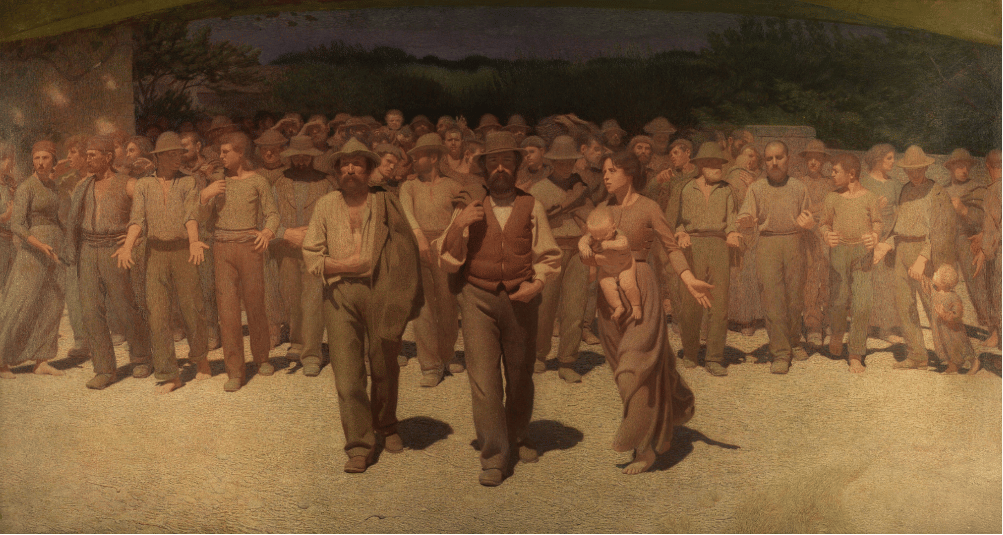
Giuseppe Pellizza da Volpedo: The Fourth Estate
🙏🏽 We need your help
We don't run ads. Mr. Thread grows because our loyal readers share it.
If you know someone who'd find our weekly journal useful, we would be very grateful if you send them the below link. Thanks!

Issue #00028: May 21st, 2026
Hello readers,
I found myself stuck in traffic on Tuesday afternoon, bumper to bumper on 485. Part of the reason I moved here from NYC was to reclaim hours of wasted time sitting in traffic jams, but in this instance I had no choice.
Here in Charlotte, they recently introduced toll lanes on the loop around the city. Pay $15, skip the traffic, shave 20 minutes off your morning while, more importantly, preserving your sanity. I use them when I can. But sitting there last Tuesday, watching the toll lane move while mine didn’t, I realized this is what the economy has quietly become: the same road, the same destination—but if you’ve got the money, you don’t have to wait with everybody else. How and when will that phenomenon hit our industry?
That thought was still rattling around when I read a New York Times piece on Air France’s La Première this week. A round-trip costs $16,000. A Mercedes limo collects you from your hotel and delivers you to an exclusive terminal entrance. Your passport is processed “offstage” while you wait in comfort. A curtain separates you from the other 300 passengers “as impenetrable as a velvet rope at a nightclub.”
None of this is marketed as exclusion. It’s sold as convenience, speed, and seamlessness. But the effect is identical to paid toll lanes—the haves in America are whizzing past the have-nots. Spirit Airlines went bankrupt while American, Delta, and United are in a business-class race to win premium flyers. The Four Seasons Maui now offers a “hotel within a hotel” so guests paying $2,600 a night don’t cross paths with guests paying $1,615. Comfort is part of it. But the real product is not having anyone else around. A depressing thought—and probably a direct result of the social media device that has become a permanent extension of our hands.
The K-shaped economy runs through every story in this issue—Toll Brothers selling homes at a $1 million average to cash buyers who don’t notice interest rates, furniture getting bludgeoned for the sixth straight month while the luxury move-up market holds.
There is something troubling about a world where the ultimate luxury product is simply not having to share a room with anyone outside your tax bracket. This divide cannot keep widening. History is not kind to societies that confuse abundance with entitlement.
Our industry exists to make spaces that bring people together—that communicate beauty, that remind us what we share rather than what separates us. The bar for effortlessness has moved, and the friction economy isn’t an abstract macro trend. It’s changing air travel, real estate, and the rooms our clients hire us to design. Our best clients have already solved friction everywhere else in their lives. The question is, how can you offer the La Première service they’re becoming accustomed to?
See you next week.
Mr. Thread
P.S. Don’t just read—play. We launched our new quiz last week, we kept it easy and a lot of you got the answer right. It’s gonna be harder today, so make sure you scroll to the bottom to enter the prize draw.
Trends

Honoré Daumier: The 3rd Class Carriage
Do furniture and fabric “brands” matter?
A new Provoke Insights survey of 1,500 Americans found that furniture ranked among the lowest of 13 categories for brand loyalty—well below apparel, alcohol, electronics, and beauty. It makes perfect sense that people have brand loyalty toward apparel and liquor (I only drink Tito’s, never Belvedere (unless Tito’s is out)).
But just one-third of consumers said brand name mattered when shopping for furniture. Nearly half said they’d buy an unbranded version if the price were lower. When brand does matter, it’s almost entirely about quality at 47%—not identity, not aesthetics, not reputation.
The numbers don’t really surprise me. Some of the biggest fabric companies in this industry—businesses doing serious volume—you’ve never heard of their names. They don’t win on branding, but because they have the best sales team, the best selection, and they nail the trends.
What furniture brands actually sell is quality. I know if I order from certain houses, the shipment arrives on time and the product holds up. That’s it. That’s the whole value of the brand. It doesn’t carry identity or aspiration the way a pair of sneakers does. Which means the moment an unbranded version looks identical and costs a third of the price, most buyers take it without a second thought. Why would anyone pay 50% more?
That’s why the numbers in this survey connect directly to a story we’re working on. More on that very soon.

Is Art Deco the new midcentury?
When “Mad Men” premiered in 2007, it did something no trade publication ever managed: it made an entire design style cool again. Over its seven-season run, Herman Miller reported a 60% increase in North American business. Then midcentury became a default—which is the beginning of the end for any aesthetic. Business of Home ran a sharp piece this week on what comes next. The answer, apparently, is art deco. Pinterest and 1stDibs both reported surges in deco searches last year, and a cache of 1930s furnishings from the de Gunzburg collection fetched a record $96 million at Sotheby’s.
The truth is, art deco is genuinely hard to pull off. Midcentury traveled because it’s so forgiving—clean lines, nothing that fights the room. Deco is the opposite. Get the proportion wrong and you’ve built a casino, not a living room.
At my brands, when we build new collections, a portion goes toward trend-responsive work. The search data and the auction records are speaking very clearly about where clients are heading, and ignoring them would be a mistake. The rest of the collection we hand to the creative team and stay out of the way. That split—Art x Commerce—is what keeps us responsive without becoming a trend factory. The designers who thrive in a deco moment will be the ones who know exactly how much is enough.
Industry

Robert Koehler: The Strike
What next for the D&D Building?
The D&D Building on Manhattan’s Upper East Side is still in default on its $150M loan—and we follow this story closely, not only because it’s one of the most important design centers in our industry, but because my company is one of the original six tenants of the building since it opened as a design center in the 1960s.
Owner Charles Cohen missed the maturity date on May 6, and his debt is now in “special servicing” (which means he’s in deep shit.) Occupancy sits at 63%, down from 95% in 2015. Annual revenue has fallen to $36.7M from $48.4M. Cohen says he’s working with the lender. He also owes Fortress Investment Group $135M from a separate default, with a deadline of yesterday, May 20. (No news on if he made it).
For over six years, half of my floor has sat empty. The building’s value to a tenant like me is the marketplace economy: designers moving between showrooms, foot traffic generating leads. When your neighbor’s space is dark, none of that works. You pay a premium for an address that should be generating traffic, and instead you’re subsidizing a vacancy you had no say in.
New ownership that runs this place like a business is what the D&D needs. Until then, for those of us inside, it’s the most expensive waiting room in New York.
“It’s business as usual. This is a maturity default. We are actively working with the lender. We are currently in the market to refinance the loan shortly.”
Trends

Ilya Repin: Barge Haulers on the Volga
Homo Faber, the artisan’s marketplace
Homo Faber—the biennial celebration of extraordinary handcraft held on the impossibly beautiful Venetian island of San Giorgio Maggiore—has launched a marketplace of 5,000 artisan workshops. Glass blowers, embroiderers, furniture makers, weavers—all now available to you and me. Take Laura Baverstock, a British grand embroiderer whose needlework appeared in “Murder on the Orient Express.” A year ago, finding her required knowing someone who knew someone. Now she’s three clicks away.
Homo Faber is one of my favorite shows of the year. Venice in early summer, that island, that level of craft—you must go at least once. My business is built around handmade work and preserving the arts, and Homo Faber is as close to the real thing as our industry ever gets. Which is also why I’ve been obsessed with it since the beginning. The show is run by the independent Michelangelo Foundation, but it has always been closely aligned with Richemont, the Swiss luxury holding company. Something about it never quite added up as just another trade event. Someone was building something.
And now, a marketplace of 5,000 artisan workshops. Think Artemest, backed by serious capital and curatorial muscle, pointing toward the Alibaba of handmade luxury. Whoever controls the platform controls access to both the maker and the buyer, and collects the toll from both sides. Wow.
The great luxury conglomerates have done more to keep these crafts alive than most governments ever will. They understand what makes handwork extraordinary. But they have capitalistic roots and they have to keep growing—and that combination has a poor track record with fragile creative ecosystems. Look at what streaming did to independent musicians. This could be extraordinary, or it could become Spotify for artisans. I’ll be watching it very closely.
Economy

Luke Fildes: Applicants for Admission to a Casual Ward
Toll Brothers is making bank
We use Toll Brothers as a bellwether economic indicator for our industry. The home builders sit in that mid-to-high market—building that first real home, the family graduation, the “move-up” buyer—which makes their numbers a useful read on where the industry is heading. They beat second-quarter guidance this week with $2.5 billion in revenue and homes delivered at an average price of $1.009 million. Net signed agreements were up 7% year over year. The luxury move-up segment now accounts for 62% of home sales revenue, up from 59% in Q1. The company raised full-year guidance.
Interestingly, 23% of buyers paid all cash. These are not people tracking mortgage rates. The K-shaped economy shows up here exactly as it does everywhere else in this issue. Is Toll Brothers outperforming because the luxury segment is holding, or because they’re simply a very well-run business? My instinct is both—and that’s the more useful lesson.
In my own businesses, we’re doing fine despite the macro headwinds, not because conditions are good, but because we’ve tightened strategy and improved the sales and marketing teams. Toll Brothers is doing the same thing at scale. You can’t control the market but you can control how you run.
The irony: if you’ve ever been inside a Toll Brothers home and opened a door or leaned on a kitchen island, you know the product feels hollow. The finishes fall apart on closer inspection. On the outside it looks fine—which, come to think of it, makes it a pretty good metaphor for the American economy right now.
“We are, quite simply, a more efficient and less cyclical home builder. Even in a difficult market, our business continues to perform well.”
Furniture bloodbath continues
One thing is clear in this economy: folks are not buying furniture. For the sixth consecutive month, furniture and home furnishings retail posted a decline. April sales came in at $11.08 billion—down 3.6% from April 2025 and down 2% from March. Through the first four months of the year, the category sits at $42.32 billion, off 3% from the same period last year. Gas stations, electronics, and sporting-goods stores all posted gains. Furniture did not.
Though America is not officially in a recession, it sure is starting to feel like one, according to many Americans. Those of us who were around in 2008 remember the lag, how it took about eight months to a year before the nightmare hit us. The furniture industry sits at the end of the project pipeline, so the pain from a market slowdown arrives long after the rest of the economy feels it. The pipeline may be drying up even as current orders still roll in. Watch Q3 and Q4.
This is one we hope to be dead wrong about. A recession on top of the housing crisis is not a good recipe for our industry. It only drives me to go out and work even harder to be sure we can snatch up the inevitable opportunities that arise during a crisis like this.
Dear Mr.Thread

George Bellows: Cliff Dwellers
I love getting mail and I reply to every one—and the mail has been good lately. Three recent letters worth sharing:
Special K.
F.V. runs a small furniture design and fabrication business focused on traditional craft. He wrote in about our K-shaped economy coverage: "Those low-end brands trying to move up tend to have more resources and, I fear, may confuse clients or crowd out true high-end shops from telling their stories—since they are usually busy doing their authentic work. But I tend to worry. We just have to be more creative." That last line stuck with me.
The AI revolt
M.C. is not in the industry—she makes custom-tailored clothing—but she connected our Foshan piece to Beth Macy’s book Factory Man, which tracks almost exactly the same story from the American side. Then she went further: “AI [is] creating a similar aesthetic revolt to the late nineteenth century’s mass industrialization. I’m rereading William Morris. It’s little wonder to me that the grandmillennial style is coming back, as are so many no-tech/lo-tech hobbies and the demand for new antiques.”
The Knick of time
S.H. wrote in after our Knicks mention in a previous newsletter. He was at Game 7 of the 1970 championship. His ticket, in the Orange Seats, cost $15. “I will never forget the moment when Willis came onto the floor. He took two practice shots, made both, and then made the first two Knicks baskets. The rest is history.” Fifty-three years of heartbreak and counting, S.H. Let’s hope this is the year.
Loose Threads
Selldorf Architects has won the competition to redesign the Louvre's entrances. Not a bad gig.
Banksy’s ‘Girl With Balloon’ sold for $18 million at Tiffany’s last week—the first major auction since his identity was revealed.
Playtime
Hats off to Parker W., Hillary E., Martin R., Amy G., Scott G., Emily S., and Tullia for correctly guessing the mystery word (LOUVRE) in our last edition. Bravo!
Ready for this week’s challenge? It’s playtime!

The Clue: The fastest way to get to Homo Faber.
Piece together the mystery word based on the clue provided above.
Click HERE to submit your answer.
Type your answer in the subject field and hit send!
The Stakes
Every correct guess earns you points that accumulate for our upcoming raffle. The more you play, the higher your chances of winning. We’ll be holding the grand draw on July 29th! Our lucky winner gets:
A featured spotlight for you/your firm in an upcoming issue of Mr. Thread.
Another special mystery gift from yours truly, Mr. Needle.
Stay sharp,
Mr. Needle
Enjoying Mr. Thread?
How can we make this better? Reply to this email and tell us. We read every message and genuinely want to know what you think.